Selasa, 23 Agustus 2022

Ottawa signs agreements with Mercedes-Benz, Volkswagen on materials for electric vehicles - The Globe and Mail

Prime Minister Justin Trudeau greets German Chancellor Olaf Scholz in Montreal on Aug. 22.Paul Chiasson/The Canadian Press

The federal government signed separate agreements with Volkswagen and Mercedes-Benz Tuesday that will see the two German auto manufacturers secure access to Canadian raw materials for batteries in electric vehicles.

Prime Minister Justin Trudeau and German Chancellor Olaf Scholz observed the signing ceremony in Toronto at an event hosted by the Canadian-German Chamber of Industry and Commerce.

In a release, Ottawa said these agreements will “help secure Canada’s position as a leading centre of excellence for the manufacturing of electric vehicles and batteries.”

The agreements include Canadian cobalt, graphite, nickel and lithium.

The Volkswagen agreement focuses on deepening co-operation on sustainable battery manufacturing, cathode active material production and critical mineral supply.

The Mercedes-Benz agreement focuses on enhancing collaboration with Canadian companies along the electric vehicle and battery supply chains and supporting the development of a sustainable critical mineral supply chain in Canada.

“(These agreements) could help fund new mine development in Canada, which is beneficial for our mining sector,” BMO mining and metals analyst, Jackie Przybylowski, said in an interview. “Canada generally has a terrific track record for sustainable mining; encouraging mining here will potentially provide sources of cleaner and more ethically sourced raw materials for electric vehicles globally.”

The agreements come one week after U.S. President Joe Biden signed a plan to provide tax credits for electric vehicles produced in North America, not only those built in the United States.

They also follow a string of promised investments by other electric-vehicle manufacturers into the Canadian automotive industry.

More than $13 billion was promised in just eight weeks this past spring to build the needed battery supply chains and shift production from combustion-engine to plug-in vehicles.

That was on top of another $3.5 billion promised in the last four years, including investments to make electric school and transit buses, produce and process critical minerals needed to make batteries, and for research and development facilities.

“There aren’t very many other countries in the world with these minerals that are governed by democracies that actually care about the environment,” Jayson Myers, CEO of advanced manufacturing organization NGen, said in an interview.

Additionally, he thinks the agreements provide “tremendous opportunities for Canadian tech and Canadian manufacturers right across the value chain.”

“It’s not just accessing the supply of minerals. It’s: how do we improve the entire process, and how do we do things much better in a environmentally-sustainable way?” he said.

Speaking in front of business leaders Tuesday alongside Scholz, Trudeau acknowledged the strength of Canada’s mining sector, explaining that the country needs to continue to show that it has the natural resources the world needs, while demonstrating that its mining industry doesn’t have to be incompatible with “progressive values, solid labour laws, care for neighbourhoods and communities” and climate change.

“There is a more pressing need for critical minerals and rare earth elements than ever before, and if we want to demonstrate a world that is cleaner and greener … we can’t continue to accept that our minerals and our inputs into our high-quality way of life need to come from authoritarian countries,” he said.

Joanna Kyriazis, program manager of clean transportation for Clean Energy Canada at Simon Fraser University, said agreements like this show that Canada’s finally capitalizing on its battery supply chain potential and emerging as a dominant player in the electric vehicle battery industry.

But at the same time, might need to pick up the pace.

“Despite being ranked high for its battery supply chain potential, very few of Canada’s metals and minerals are actually making their way into batteries right now,” she said.

“A number of new mines and associated infrastructure will have to be developed if Canada wants to capture any significant electric vehicle battery mineral market share by 2030.”

In its most recent budget, the federal government announced its first-ever critical minerals strategy, allocating $3.8 billion toward manufacturing, processing, and recycling projects, but Kyriazis said more could be done to move the needle faster, such as accelerating mining permitting times while meeting the highest environmental, social and governance standards, including Indigenous consultation and partnership.

“It will likely also require building out mining infrastructure in advance to ensure companies can access new mines plus servicing them with sufficient clean electricity to make good on Canada’s clean battery promises,” she said.

Prime Minister Justin Trudeau and German Chancellor Olaf Scholz observed the signing of separate agreements with Volkswagen and Mercedes-Benz that will see the two German auto manufacturers secure access to Canadian raw materials for batteries in electric vehicles. Trudeau says Canada is a reliable strategic partner when it comes to the EV future.

The Canadian Press

Our Morning Update and Evening Update newsletters are written by Globe editors, giving you a concise summary of the day’s most important headlines. Sign up today.

Adblock test (Why?)


https://news.google.com/__i/rss/rd/articles/CBMicGh0dHBzOi8vd3d3LnRoZWdsb2JlYW5kbWFpbC5jb20vY2FuYWRhL2FydGljbGUtb3R0YXdhLXNpZ25zLW1vdXMtd2l0aC1tZXJjZWRlcy1iZW56LXZvbGtzd2FnZW4tb24tbWF0ZXJpYWxzLWZvci_SAQA?oc=5

2022-08-23 14:46:53Z
1543176944

Twitter's former security chief files whistleblower complaint alleging misleading practices - CBC News

A former head of security at Twitter alleged that the company misled regulators about its cybersecurity defenses, privacy protections and its ability to detect and root out fake accounts, according to a whistleblower complaint filed with U.S. officials.

The revelation could create serious legal and financial problems for the social media platform, which is currently attempting to force Tesla CEO Elon Musk to consummate his $44 billion offer to buy the company.

Peiter Zatko, Twitter's security chief until he was fired early this year, filed complaints last month with the U.S. Securities and Exchange Commission, the Federal Trade Commission and the Department of Justice. The legal nonprofit Whistleblower Aid, which is working with Zatko, confirmed the authenticity of a redacted copy of the complaint posted online by the Washington Post.

Among Zatko's most serious accusations is that Twitter violated the terms of a 2011 FTC settlement by falsely claiming that it had strong security measures in place to protect the security and privacy of its users. Zatko also accuses the company of deceptions involving its handling of "spam" or fake accounts, an allegation that is at the core of Musk's attempt to back out of the Twitter takeover.

Shares of Twitter Inc. slid 5.4 per cent Tuesday. Zatko didn't immediately respond to a request for comment Tuesday. But he told the Post he "felt ethically bound" to come forward.

Better known by his hacker handle "Mudge," Zatko is a highly respected cybersecurity expert who first gained prominence in the 1990s and later worked in senior positions at the Pentagon's Defense Advanced Research Agency and Google.

He joined Twitter at the urging of then-CEO Jack Dorsey in late 2020, the same year the company suffered an embarrassing security breach involving hackers who broke into the Twitter accounts of world leaders, celebrities and tech moguls, including Musk, in an attempt to scam their followers out of bitcoin.

Twitter said in a prepared statement Tuesday that Zatko was fired for "ineffective leadership and poor performance" and said the "allegations and opportunistic timing appear designed to capture attention and inflict harm on Twitter, its customers and its shareholders." The company called his complaint "a false narrative" that is "riddled with inconsistencies and inaccuracies and lacks important context."

Zatko's attorneys, Debra Katz and Alexis Ronickher, said Twitter's claim about his poor performance is false and that he repeatedly raised concerns about "grossly inadequate information security systems" with top executives and Twitter's board of directors. The lawyers said that in late 2021, after the board was given "whitewashed" information about those security problems, Zatko escalated his concerns, "clashed" with CEO Parag Agrawal and board member Omid Kordestani and was fired two weeks later.

The 84-page complaint describes a broken corporate culture at Twitter that lacked effective leadership and where Zatko said top executives practiced "deliberate ignorance" of pressing problems. His description of Dorsey's leadership style is particularly scathing, saying the Twitter founder was "extremely disengaged" during the last months of his tenure as CEO to the point where he would not even speak during meetings on complex issues facing the company.

Zatko said he heard from colleagues that Dorsey would remain silent for "days or weeks." Dorsey announced he was stepping down as Twitter CEO in November 2021.

The disclosure says Twitter offered no monetary incentives for improving security and platform integrity, although the company did offer $10 million bonuses last year for top executives who could generate short-term user growth.

Among Zatko's damning accusations of cybersecurity malpractice: Software and security updates were disabled on more than a third of employees' computers — unduly exposing them to malware — and it was common for people to install "whatever software they wanted on their work systems." Such lapses are typically considered cardinal sins in cybersecurity.

Whistleblower Aid said it is legally precluded from sharing Zatko's statement. The same group worked with former Facebook employee Frances Haugen, who testified to Congress last year after leaking internal documents and accusing the social media giant of choosing profit over safety.

A spokesperson for the U.S. Senate's intelligence committee, Rachel Cohen, said the committee has received Zatko's complaint and "is in the process of setting up a meeting to discuss the allegations in further detail. We take this matter seriously."

Sen. Dick Durbin, an Illinois Democrat, said in a prepared statement that if the claims are accurate, "they may show dangerous data privacy and security risks for Twitter users around the world."

Among the most alarming complaints is Zatko's allegation that Twitter knowingly allowed the Indian government to place its agents on the company payroll where they had "direct unsupervised access to the company's systems and user data."

'Highly sensitive data'

A 2011 FTC complaint noted that Twitter's systems were full of highly sensitive data that could allow a hostile government to find precise location data for specific users and target them for violence or arrest. Earlier this month, a former Twitter employee was found guilty after a trial in California of passing along sensitive Twitter user data to royal family members in Saudi Arabia in exchange for bribes.

The complaint said Twitter was also heavily reliant on funding by Chinese entities and that there were concerns within Twitter that the company was providing information to those entities that would enable them to learn the identify and sensitive information of Chinese users who secretly use Twitter, which is officially banned in China.

Zatko also describes "deliberate ignorance" by Twitter executives on counting the millions of accounts that are automated "spam bots" or otherwise have no value to advertisers because there is no person behind them.

Alex Spiro, a legal representative for Musk, told CBC News that Musk's team has issued a subpoena for Zatko, saying: "We found his exit and that of other key employees curious in light of what we have been finding."

Adblock test (Why?)


https://news.google.com/__i/rss/rd/articles/CBMiT2h0dHBzOi8vd3d3LmNiYy5jYS9uZXdzL2J1c2luZXNzL3R3aXR0ZXItc2VjdXJpdHktY2hpZWYtd2hpc3RsZWJsb3dlci0xLjY1NTk1MzDSAQA?oc=5

2022-08-23 19:02:37Z
1544273793

Saudi Warnings Touch Off Market Swings - Bloomberg Markets and Finance

Adblock test (Why?)


https://news.google.com/__i/rss/rd/articles/CBMiK2h0dHBzOi8vd3d3LnlvdXR1YmUuY29tL3dhdGNoP3Y9eWJ1cGZjQnNPQ1HSAQA?oc=5

2022-08-22 23:24:17Z
1539353472

Senin, 22 Agustus 2022

Elon Musk subpoenaes former Twitter CEO Jack Dorsey - CBC News

Tesla CEO Elon Musk has subpoenaed his friend and former Twitter CEO Jack Dorsey as part of an effort to back out of his $44 billion US agreement to acquire the company Dorsey helped found, according to court documents.

Twitter and Musk are headed for an Oct. 17 trial in Delaware that should determine whether or not Twitter can force the billionaire to go through with the acquisition.

Twitter has subpoenaed a host of tech investors and entrepreneurs connected to Musk, including prominent venture capitalist Marc Andreessen and David Sacks, the founding chief operating officer of PayPal.

Musk has claimed that Twitter failed to provide adequate information about the number of fake, or "spam bot," Twitter accounts, and that it has breached its obligations under the deal by firing top managers and laying off a significant number of employees.

Musk's team expects more information about the bot numbers to be revealed in the trial court discovery process, when both sides must hand over evidence.

Twitter says Musk has buyer's remorse

Twitter argues that Musk's reasons for backing out are just a cover for buyer's remorse. Shortly after Musk agreed to pay 38 per cent above Twitter's stock price, the stock market stumbled and shares of the electric-car maker Tesla, where most of Musk's personal wealth resides, lost more than $100 billion US of their value.

The subpoena was served last week. It asks Dorsey for documents and communications related to the acquisition, as well as information on the effect of fake or spam accounts on Twitter's business and its measurement of daily active users.

A lawyer representing Dorsey did not immediately respond to a message for comment on Monday.

Adblock test (Why?)


https://news.google.com/__i/rss/rd/articles/CBMiS2h0dHBzOi8vd3d3LmNiYy5jYS9uZXdzL2J1c2luZXNzL2Vsb24tbXVzay1zdWJwb2VuYWVzLWphY2stZG9yc2V5LTEuNjU1ODgyMtIBAA?oc=5

2022-08-22 20:24:22Z
1538312276

Tip-flation has some restaurants asking for up to 30% in tips - CBC.ca

The amount Canadians are being asked to tip when paying with credit or debit cards is going up, according to industry watchers, and it could be encouraging Canadians to be more generous with gratuities.

A survey conducted by Restaurants Canada in April 2022 found that when dining out at a table service restaurant, 44 per cent of 1500 Canadians surveyed said their tips are higher compared to before the COVID-19 pandemic. 

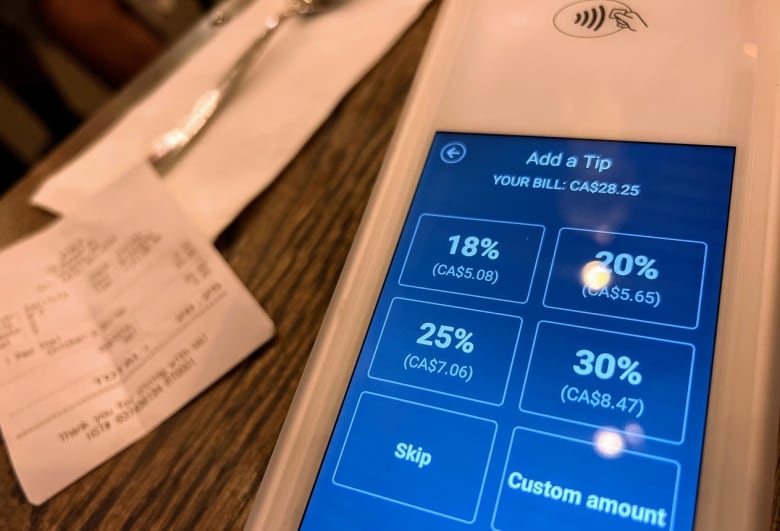
Suggested tips are increasing as well, according to CBC Calgary restaurant reviewer Elizabeth Carson, who noted prompts on credit card machines that previously asked for tips of 10 to 20 per cent have now crept up to 18, 20 or 25 per cent.

Carson has also been asked to tip as much as 30 per cent, and said she finds the higher prompts annoying. It's leading to an overall feeling that could be called tip-flation.

A payment machine asking for a 30 per cent tip is shown next to a pile of receipts on a table.
This point-of-sale terminal at a Toronto restaurant asks for tips ranging from 18 to 30 per cent by default. (Anis Heydari/CBC)

"Because food and wages cost more, the bill is now 10 per cent higher than it used to be. So it still equals a very large tip because the bill is so high," said Carson.

The restaurant reviewer, who typically eats out three to six times a week, started noticing this trend during the first COVID-19 lockdown.

"Restaurants couldn't do anything but takeout. People felt very badly for restaurant workers, and so people were leaving much higher percentages than the suggested tip levels," said Carson.

Carson suggested restaurants noticed that customers were willing to tip more, so they began asking for more. 

How your choices are shaped

While a customer's choice may feel like their own, decisions like how much to tip can be influenced by a theory called "choice architecture," or how choices are presented to us.

Simon Pek of the University of Victoria's Gustavson School of Business looks at these influences in his research on tipping practices.

If those numbers are higher, it makes us think that a higher tip is more appropriate.- Simon Pek, Associate Professor, University of Victoria

The pre-set choices for a tip at the end of your restaurant transaction are an example of choice architecture, according to Pek. 

"When you see the point-of-sale device, the message being sent to you is that tipping is expected or is a norm in this particular context," he said.

Simon Pek researches tipping at the University of Victoria and has said when higher tipping percentages are presented, customers can feel they should tip more. (UVic Photo Services)

"The first number you see, or the range you see in front of you influences people's decisions and perceptions about what the right tip to do in that particular context is."

"So if those numbers are higher, it makes us think that a higher tip is more appropriate in this context."

Unclear how often 30 per cent tips happen

Financial technology companies such as Square or Moneris don't share data on how often Canadians choose the 30 per cent tip option. 

However, Square did confirm that it is up to sellers and retailers to enable and customize the tip settings on point-of-sale terminals.

Some restaurateurs have said raising the tip options for customers who pay by debit or credit card could backfire, including Jacquie Titherington, a server and manager at Blue Star Diner in Calgary.

"I feel like it's pushing something that isn't necessarily going to work in favour of the employees because I think that when people see that, it might be a bit of a turnoff because it seems excessive," said Titherington, who has 26 years of experience in the restaurant industry.

Zoe Smith, who recently left her job at a pub in Victoria to go travelling, says she can't afford to leave a 30 per cent tip when she dines out — so she doesn't expect customers to either.

"I think when I do a good job, I expect no more than 18 per cent. And if I receive more than that, I'm happy and grateful, but … we're all kind of struggling out here, like everyone is trying to make ends meet," said Smith.

Between July 2020 and July 2022,  Square tracked the amount that Canadians tip on in-person transactions. The average gratuity hovered around 17 per cent nationally, which was up one per cent from pre-pandemic times.

Provincially, British Columbians left the lowest tips — an average of 16.7 per cent, compared to Newfoundlanders who were Canada's top tippers according to Square's data, with an average gratuity of 18.6 per cent. 

Tip distribution can vary by province

In Canada, either the employee or the employer can control the distribution of gratuities.

In restaurants where servers collect all tips from customers, they will often pass on a percentage of those earnings to their coworkers such as hosts and hostesses, bussers, dishwashers and cooks. 

When tips are controlled by the employer, they can be pooled together and distributed to staff through a tip-sharing arrangement set out in an employment contract.

It is up to sellers to enable and customize the tip setting on point-of-sale terminals, according to the financial technology company Square. (Danielle Nerman/CBC)

In some cases, restaurant owners are included in this arrangement and take what's called the house cut. However, this practice is illegal in Ontario, Quebec and New Brunswick and a grey area in many other jurisdictions, including Alberta.

When Sean Gandossi worked at a pizza takeout counter in Calgary, he never saw any of his tips.

"We did have a tipping option on the [point-of-sale] machine there… and we made great money in tips, like some nights it was upwards of $1,000 but none of that money went to us at all," said Gandossi.

  • The Cost of Living ❤s money — how it makes (or breaks) us.
    Catch us Sundays on CBC Radio One at 12 p.m. (12:30 p.m. NT).
    Subscribe to our podcast and get the show early, every Friday night.

The owners told him they reinvested those tips into the business and Gandossi, who was 17 years old at the time, didn't argue with the arrangement because he was making $17.50 per hour. 

"When you're kind of a bit younger too, you know, you think, okay, well, I'm making more than minimum wage … so, you know, I didn't complain about it much because I just didn't really know much better," he told CBC Radio's The Cost of Living.

Ask who gets your tip, no matter the percentage

Gandossi said he believes most customers were unaware that their tips were going to the owners of the restaurant and not the staff.

"You're the one giving them the machine, right? You're the one kind of prompting the tip selection or the tipping option," said Gandossi.

The tips you give to restaurant staff through point of sale machines like this do not always have to go through to the restaurant staff, say former servers. (Steve Bruce/CBC)

"It's kind of like when you have a tip jar out. You're going to assume if you put money in the tip jar that the person you see, they're going to be the ones getting the tips."

Experts such as tipping researcher Simon Pek say if a customer wants to know where their tip is going, they should ask.

Adblock test (Why?)


https://news.google.com/__i/rss/rd/articles/CBMiRWh0dHBzOi8vd3d3LmNiYy5jYS9yYWRpby9jb3N0b2ZsaXZpbmcvdGlwZmxhdGlvbi1ncmF0dWl0aWVzLTEuNjU1NTEzNdIBIGh0dHBzOi8vd3d3LmNiYy5jYS9hbXAvMS42NTU1MTM1?oc=5

2022-08-22 08:00:00Z
1539366155

Minggu, 21 Agustus 2022

B.C. strike: Expert says province in for a 'bumpy ride' | CTV News - CTV News Vancouver

With B.C. Liquor Distribution Branch workers on strike, orders to private liquor stores, bars and restaurants across the province have come to a screeching halt

“We should see stock-outs over the weekend for those popular items,” said Kieran Baldwin, general manager of Legacy Liquor Store in Olympic Village.

“We’ll definitely be running out of stuff,” added Allura Fergie, co-owner of Fets Whisky Kitchen on Commercial Drive.

The LDB workers are part of the approximately 33,000 public sector employees represented by the BC Government Employees Union (BCGEU). The strike action is part of the union's strategy as it negotiates a new contract with the provincial government.

“Wage increases that allow them to catch up,” said BCGEU president Stephanie Smith when asked what the workers are aiming for.

“Also, just as important, some form of inflation protection for those wages – The same sort of protection wages that they themselves as MLAs enjoy and have enjoyed since 2007.”

The BCGEU already turned down an offer of roughly an 11 per cent increase over three years, plus a $2,500 signing bonus.

“I think the unions are going to draw a line in the sand here around this,” said Christopher McLeod, professor of occupational environmental health at UBC.

“I think we’re going to be in for a little bit of a bumpy ride.”

McLeod says it could be a potentially costly and precedent-setting contract for the NDP government to sign, as other public sector unions such as the BC Nurses’ Union and the BC Teachers’ Federation could follow suit under the "Me too clause," meaning whatever the BCGEU gets in the contract, they could get as well.

“That actually introduces fiscal uncertainty for the government in terms of how much they can commit to, so it’s a challenging environment,” said McLeod.

Finace Minister Selena Robinson hasn’t been made available for comment regarding negotiations, with the ministry directing CTV News to a statement sent out Aug. 15 from Ravi Kahlon, the province's Minster of Jobs, Recovery and Innovation.

“Our government’s Shared Recovery Mandate offers the most generous wage increase in at least the last 30 years,” reads the statement. “It provides an extra lift to the lowest-paid workers who are hardest hit during periods of high inflation, and is designed to provide workers with money in their pockets sooner rather than later.”

Meanwhile, Smith hinted at more job action if talks continue to stall.

“The tool in the toolbox that workers have in terms of their leverage is withdrawing their labour,” said Smith.

Smith wouldn’t confirm specific numbers the BCGEU is looking for, or what other job action may occur if the collective bargaining process doesn’t reach a conclusion.

In addition to the BCGEU, nearly 350,000 more public sector workers are also seeking new contracts with the provincial government.   

Adblock test (Why?)


https://news.google.com/__i/rss/rd/articles/CBMiY2h0dHBzOi8vYmMuY3R2bmV3cy5jYS9tZS10b28tY2xhdXNlLWNvdWxkLW1ha2UtZm9yLWEtYnVtcHktcmlkZS1pbi1iLWMtdW5pb24tbmVnb3RpYXRpb25zLTEuNjAzNTg4NNIBAA?oc=5

2022-08-20 23:56:00Z
1529340139

How the luxury fitness bubble popped as the pandemic wore on - CBC News

Gym rats, take heed: The luxury fitness boom may very well be cooling down as high-end exercise brands like Peloton and SoulCycle struggle to make gains at this stage of the pandemic.

Peloton — the company behind a line of gadget-forward stationary bikes that enjoyed a swell of business during the early lockdown period — announced layoffs, studio closures and price hikes on its signature product in Canada and the U.S. this month, following a sharp decline in sales. 

Another high-end fitness brand is struggling, outside the home: SoulCycle, the chain of group cycling studios that launched in 2006, closed 25 per cent of its locations earlier this week. 

That includes a complete exit from the Canadian market with the shutdown of its lone Toronto studio, the company confirmed to CBC News.

"I think that explains the kind of popularity at the lower end of the consumer fitness market in terms of brick and mortar," said Natalia Petrzela, an associate professor at the New School in New York and author of Fit Nation: The Gains and Pains of America's Exercise Obsession.

"More people are going back to the gym in person, but it is the lower-end businesses that are thriving."

The fitness industry is between a rock and a hard place, with two previously reliable business models floundering at this stage of the pandemic. While in-person studios are still recovering from government shutdowns, at-home fitness brands are losing clientele while people favour affordable brick-and-mortar gyms and fitness centres. 

A woman walks past a SoulCycle fitness studio in Lower Manhattan in New York City. The chain of group cycling studios that launched in 2006 closed 25 per cent of its locations earlier this week. (Drew Angerer/Getty Images)

Small gym owners still getting back on their feet

As pandemic-related measures relax, people are "re-evaluating their relationship to what they spend on exercise and why they want to work out," said Petrzela.

"What Peloton is experiencing is kind of a correction — not even a failure — but a correction on that over-the-top enthusiasm and excitement for home fitness at a moment when so many people had no other options," she said.

The company reported in May that its third quarter revenue fell short of expectations, taking in $964.3 million, a decline from the $1.26 billion it raked in a year earlier. Its market value plummeted by $46 million as pandemic-driven demand for at-home fitness dried up.

"But at the same time people aren't going back to work out in the same way that they did before," said Petrzela. "So something like SoulCycle, which was the darling of the boutique fitness industry, has to adjust as well."

Sergio Pedemonte, the CEO of personal training company Your House Fitness, says that he's still struggling to find trainers after a mass exodus from the industry in 2020. (Submitted by Sergio Pedemonte)

Even as affordable gym chains thrive, small business owners are picking up the pieces two years later. One of the ongoing challenges is a shortage of qualified personal trainers, according to a Toronto-based business owner. 

"There are too many personal training companies, too many gyms that require trainers, but there are no trainers," said Sergio Pedemonte, the CEO of personal training company Your House Fitness. Pedemonte runs both an at-home service and a studio and gym.

He says that he's still struggling to find trainers after a mass exodus in 2020, when many in the industry left to pursue other ventures while CERB payments provided a financial safety net.

"I think that the biggest struggle of all these in-mortar companies is that their [monthly] build-up has gone down," he said, after provincial governments shut down and restricted gym access. His business was making roughly $100,000 in monthly membership revenue when the pandemic hit — that number then swiftly fell to zero.

The brick-and-mortar studio of Your House Fitness in Toronto is pictured. (Your House Fitness)

Sara Hodson, the president of the Fitness Industry Council of Canada, said that business owners are still reckoning with the challenges and changing consumer behaviour of 2020.

"You look at an industry that was shut down, that lost all of its revenue, that had to stay afloat, and at the same time had to reinvest in technology in order to do everything that we could to keep Canadians active," said Hodson from Vancouver.

Future business models will focus on mind-body health

The Canadian fitness industry's market size expanded in 2022 and is now on par with pre-pandemic numbers after a two-year slump, according to market research firm IBISWorld. Petrzela said more consumers have come into fitness during the pandemic.

"This is a result of the fact that the pandemic and its kind of enforced sedentary-ness led a lot of people to realize that exercise really is very important, both for general well-being and — honestly — in terms of certain COVID comorbidities," she said.

'More people are going back to the gym in person, but it is the lower-end businesses that are thriving,' said Natalia Petrzela, the author of Fit Nation: The Gains and Pains of America's Exercise Obsession. (Sylvie Rosokoff)

Because so many people invested in high-end home fitness setups (a basic Peloton setup has a price tag of about $1800 Cdn), most won't be willing to "shell out on a high-end health club or boutique experience," she said. Hence, the shunning of SoulCycles and Flywheels in favour of GoodLifes and Fitness Worlds.

In an industry that yo-yos between trends, Hodson and Petrzela agree that the next phase of fitness and lifestyle branding will remain a hybrid model of virtual and in-person connection.

"What we're really seeing across the industry and even when we look at global trends is this massive return to in-person connection," said Hodson, who is also the CEO of gym chain Live Well Exercise Clinic.

Globally, the fitness industry is seeing a 'massive return to in-person connection,' said Sara Hodson, president of the Fitness Industry Council of Canada. (Submitted by Sara Hodson)

She said she has observed that her older clientele are more open and able to engage with virtual classes as a result of the pandemic, but are also returning to the company's brick-and-mortar facility.

"I think that the next popular business model is going to combine connected fitness, in-person experience and community," said Petrzela. "That'll probably engage meditation, recovery, stretching, maybe even certain forms of therapy, quite honestly, that fit under that mind-body health bracket."

"But I think that there is no question that connected fitness and home fitness is here to stay."

Adblock test (Why?)


https://news.google.com/__i/rss/rd/articles/CBMiRGh0dHBzOi8vd3d3LmNiYy5jYS9uZXdzL2J1c2luZXNzL2x1eHVyeS1maXRuZXNzLWJ1YmJsZS1wb3AtMS42NTU0MTUz0gEA?oc=5

2022-08-21 08:00:00Z
CAIiEA_QcyCS9SXo2-zEcVQQUQQqFggEKg4IACoGCAowqKNmMKjdCjDBjx0