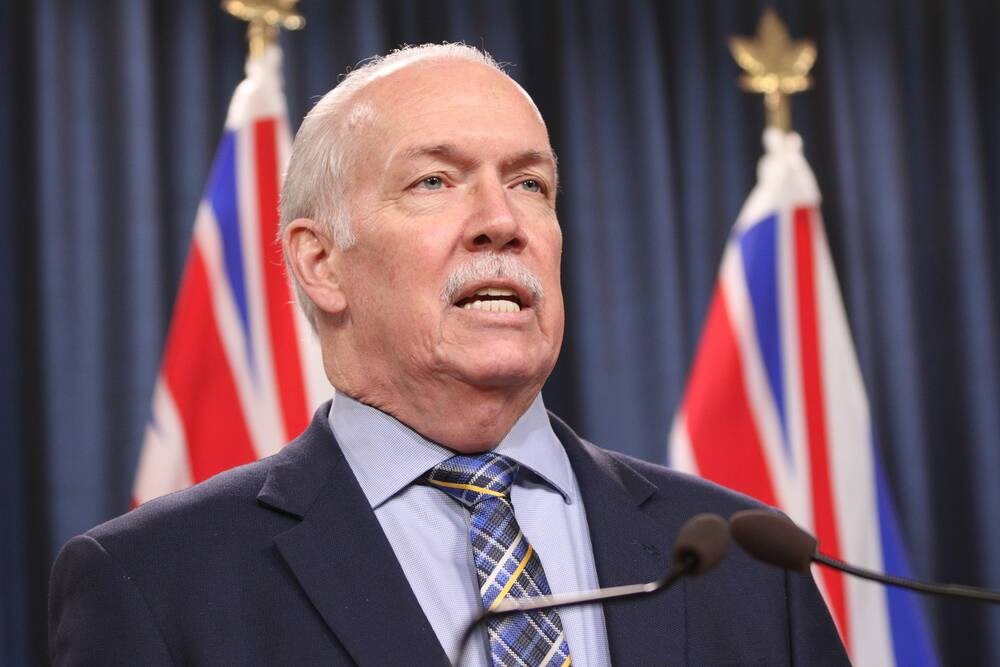
British Columbia’s public auto insurer is giving a one-time rebate to help drivers cope with the cost of rising fuel prices caused by Russia’s invasion of Ukraine, Premier John Horgan announced Friday.
The Insurance Corporation of B.C. will provide a $110 rebate to most drivers who have a basic auto insurance policy and a $165 rebate to most commercial drivers because they have tend to have higher expenses.
Eligible ICBC clients will receive the rebate in May through a direct deposit, if they have that set up with ICBC, or via a credit-card refund. Cheques will be sent in June to all other eligible clients.
“Today, if we go to fill up at the pumps, sometimes it feels like it’s a bit of a holdup,” Horgan told a news conference. “Prices are at unprecedented levels and those prices at the pump are a direct result of (Russian President) Vladimir Putin’s invasion of Ukraine.”
Horgan said the one-time payment is a better approach than cutting fuel taxes because the price will only increase again at the pumps.
He said ICBC is in a financial position to cover the total rebate cost of $395 million. It is forecasting an annual net income of $1.9 billion for the 2021-22 fiscal year ending March 31.
In 2018, David Eby, who was then the minister in charge of the insurance corporation, compared the finances of the public auto insurer to a dumpster fire.
The NDP brought in legislation to prevent governments from dipping into reserves at the corporation “to pad their budgets,” Horgan said Friday.
But the difference with the rebate, he said, is that the money is going back to policy holders, who finance the corporation.
“This is a rebate based on the robust position the corporation is in,” Horgan said.
Prof. Werner Antweiler, an economist at the University of British Columbia, said the relief payment will help as the market deals with a shortage of gasoline.
“The idea is we’re not interfering in the market. The market needs to do its magic of closing the gap between supply and demand through higher (gas) prices,” he said in an interview. “The higher prices are necessary.”
Antweiler said the focus needs to be on giving financial relief to commercial drivers because, in theory, if they get help, they won’t pass added costs on to consumers.
Peter Milobar, the B.C. Liberal party’s finance critic, said the government’s approach doesn’t target help at those who need it most as everyone gets the same rebate, including owners of electric vehicles.
“The fact that a single parent working two jobs and driving a Honda Civic is getting the same one-time rebate as a Tesla owner is ridiculous,” he said in a news release. “Not everyone feels the impacts of these sky-high prices the same.”
B.C.'s premier says the ICBC rebate is meant to ease the financial burden of increased gas prices caused by the invasion of Ukraine by Russian forces.
Publishing date:
Mar 25, 2022 • 8 hours ago • 3 minute read • 105 Comments
Michael Santos fills up his car in Vancouver on Friday.Photo by RICHARD LAM /PNG
Article content
Premier John Horgan’s offer of $110 rebates to ICBC policy holders as a “one-time relief payment” to help consumers with high gasoline prices isn’t going to go very far, according to drivers who were filling up in Vancouver on Friday.
Advertisement 2
Article content
“It’s a stop-gap. It doesn’t address (high gas prices) long-term,” said Michael Santos, a Vancouver sales and business-development representative who was at an Esso station at Burrard and Davie where regular gas was 195.9 cents per litre.
With Vancouver gas prices hovering around $2 per litre, the $110 rebate will pay for about three weeks worth of driving for Santos, who now thinks twice about making sales visits.
“If it’s expensive to go there, it doesn’t make prospecting very lucrative,” Santos said.
The $110 represents about one tank of gas for Langley teacher Tracy Croutch.
“I know it’s a gesture, but it doesn’t really help,” said Croutch, who would simply prefer lower prices.
Horgan, however, said the one-time payment is “a significant contribution at a very difficult time for drivers as they look at the price at the pump and know that there’s relief on the way,” in announcing the payment along with Public Safety Minister Mike Farnworth.
Advertisement 3
Article content
Soaring gas prices are in part the result of Vladimir Putin’s invasion of Ukraine, Horgan said, and the volatility is hurting consumers worldwide, not just in B.C. ICBC’s robust financial results allow the corporation to offer this measure of relief.
Government critics, however, called the rebate a political move that doesn’t deliver the relief consumers need or get at the root problem of unaffordability.
“This is simply them trying to get out of what they’re obviously getting bad polling numbers on, and trying to figure out a way to change the dial,” said Kamloops-North Thompson MLA Peter Milobar during an appearance on pundit Mike Smyth’s show on CKNW.
The rebate will cost ICBC $395 million and will be paid out as $110 rebates to individual policy holders and $165 for commercial-vehicle policy holders. It will go to customers who held basic insurance policies with the Crown corporation in the month of February.
Advertisement 4
Article content
A rebate, however, is something ICBC could have offered regardless of the crisis and could have been more generous, said policy analyst and retired civil servant Rick McCandless.
“They’re linking it to trying to help out at the gas pump, and that’s fine, but the main purpose is to give back excess money (to ICBC policy holders),” McCandless said.
McCandless estimated ICBC has as much as $450 million in capital that is excess to its legislated need for reserve funds, which could have been paid out in rebates of $125 to $150.
That is based on an analysis of the corporation’s publicly available financial information McCandless published after the province released its latest budget.
McCandless said gas prices are being driven up by more factors than just the invasion of Ukraine, but a resolution to the war would start to ease prices and “take the pressure off governments to do something right by the taxpayer.”
Advertisement 5
Article content
“In the meantime, because of the risks (of) a potential recession, the government has to take some measure to provide relief,” he said.
Milobar, however, who is also the B.C. Liberal finance critic, said rebates don’t target the people who need the help most and gives it to those who need it the least.
“The fact that a single parent working two jobs and driving a Honda Civic is getting the same one-time rebate as a Tesla owner is ridiculous,” Milobar said in a statement.
B.C. Green party leader Sonia Furstenau said it was shortsighted to target rebates only for drivers when “the affordability crisis, made worse by rising gas prices, affects all British Columbians.”
“Whenever there is an opportunity for transformative change, the B.C. NDP doubles down on the status quo,” she said in a series of Tweets published Friday.
Furstenau said the government would be better off if it took the $395 million and “leaned into permanent solutions to transportation problems in this province.”
She added that a better way to deal with the crisis would be to look at using the $2 billion generated by the carbon-tax to provide more generous and consistent rebates to “encourage a shift away from oil and gas.”
The Public Utilities Board has made another adjustment to some fuel products.
There is no change in the price of gas, but the regulated price of diesel is up again by nearly 10 cents a litre.
Furnace heating oil is up by 11.51 cents and stove oil is up 8.15 cents a litre.
The notification to media outlets usually comes on the evening before the adjustment, but a technical error means that media outlets were only notified around 9:30 this morning.
By the end of this year, Canadian producers will be positioned to export an extra 200,000 barrels a day of oil to the U.S., as well as natural gas equivalent to 100,000 barrels of oil.Todd Korol/Reuters
Canada says its producers can boost exports of oil and natural gas to the United States this year, as part of an international effort to help the world move away from Russian energy after Moscow’s invasion of Ukraine.
By the end of this year, Canadian producers will be positioned to export an extra 200,000 barrels a day of oil to the U.S., as well as natural gas equivalent to 100,000 barrels of oil, Natural Resources Minister Jonathan Wilkinson said during a conference call from Paris on Thursday after a meeting of the International Energy Agency (IEA).
The increase is intended to free up oil and gas supplies in the U.S. and elsewhere, so that those countries can in turn reroute fuel to the European Union, which relies on Russia for roughly one third of the oil it consumes, and 40 per cent of its natural gas.
The anticipated rise in Canada’s oil and gas exports would be relatively small, but Mr. Wilkinson said every bit counts in the effort to strengthen global supplies outside Russia. He estimated that the extra Canadian oil exports to the U.S. would represent an increase of five per cent over existing shipments.
Canada is limited in its ability to make big gains in oil and gas output owing to scarce new export pipeline capacity.
“It will take some time to fully move away from Russian oil and gas for some of these countries like Germany that are quite heavily dependent,” Mr. Wilkinson said. “Any additional amounts can help to start that process.”
Europe’s reliance on oil and gas supplies from Russia is a situation the North Atlantic Treaty Organization and the IEA are pushing hard to reverse. Canada, the U.S. and the United Kingdom have already banned Russian oil products in the weeks since the start of the Ukraine invasion, but the European bloc’s need for Russian fuel for heat and power has made it reluctant to do the same.
“Canada stands in steadfast support of the Ukrainian people and our European friends and allies,” Mr. Wilkinson said. “We need to ensure that we are thinking about both energy security and climate change concurrently.”
Calgary-based Enbridge Inc. ENB-T said in a statement that while there are constraints in its pipeline export capacity, company officials have been talking to government representatives about ways to alleviate the energy crisis.
“Enbridge is pleased the government of Canada is taking steps to advance global energy security and the transition to a net-zero emissions economy,” the company said.
Environmental groups criticized global efforts to bolster oil and gas supplies outside Russia. “Corporate interests are cynically seizing on this moment to push forward an agenda to entrench fossil fuel dominance for decades to come,” said Food & Water Watch, a Washington-based non-governmental organization.
Canada’s export capacity is not limited only by a lack of pipelines. The country’s first major liquefied natural gas terminal capable of exporting the fuel in tankers, Shell PLC-led LNG Canada, is still under construction. The $18-billion terminal in Kitimat, B.C. will ship liquefied natural gas to Asia. It won’t open until 2025 at the earliest.
A practical roadmap for achieving independence from Russian fuels has been the subject of “intense back-and-forth” in recent weeks, U.S. National Security Advisor Jake Sullivan told reporters this week.
The U.S. and the European Commission are expected to release more details on an energy security plan soon, but Mr. Sullivan said replacing Russian exports is not simply a matter of diverting liquefied natural gas in the short term. Rather, it will involve structural changes aimed at creating more flexibility for different policy choices in Europe. It will also mean increasing U.S. liquefied natural gas supplies to the continent over the coming months and years.
IEA executive director Fatih Birol said all member countries came to the organization’s summit this week armed with plans, policies and various other tools to reduce reliance on Russian oil and gas.
“They were different policies, different measures, different timelines, but one single target – reducing, radically, Russian oil and gas imports,” he said.
Prime Minister Justin Trudeau said following a G7 summit inBrussels on Thursday that, despite Canada’s role in helping wean Europe off Russian oil and gas, the federal government remains committed to hitting net-zero carbon emissions by 2050.
“Indeed, the partnerships we’re looking at building with the European Union – on issues of hydrogen, on issues touching renewables – are very promising in terms of getting the world not just off Russian oil and gas, but decarbonizing our energy economy entirely,” he told reporters.
Mr. Trudeau said in a joint statement with European Commission President Ursula von der Leyen that officials will meet this week to discuss enhancing energy-related co-operation and eliminating the European bloc’s dependence on Russian energy.
“A dedicated working group on green transition and LNG is being created to develop a concrete action plan on these matters,” the statement said.
Your time is valuable. Have the Top Business Headlines newsletter conveniently delivered to your inbox in the morning or evening. Sign up today.
Federal and Ontario politicians have been tight-lipped about the amount of money the government is investing to secure a new electric vehicle (EV) battery manufacturing plant in Windsor, Ont., but a Toronto-area MP shared in a tweet that Ottawa's contribution is $500 million.
During an announcement Wednesday for what is being called the "largest automotive investment in the history," prominent politicians — including Ontario Premier Doug Ford and federal ministers of transport and innovation — would not disclose the financial incentives that the government had offered to secure the $4.9-billion factory in Canada.
When asked for dollar amounts, Ford said, "I can't divulge that. It would compromise some negotiations moving forward with other companies as well, but it's a massive investment and its hundreds of millions of dollars."
On Wednesday afternoon, MP for Toronto—Danforth Julie Dabrusin, who also attended the announcement in Windsor, said the federal government is contributing $500 million toward the project.
This tweet by Dabrusin was deleted Thursday. (Julie Dabrusin/Twitter)
"Today, on behalf of Minister [Jonathan Wilkinson], I joined Ministers [Francois-Philippe Champagne] and [Omar Alghabra] in Windsor to announce $500M in federal funding to support a historic investment by LGES and Stellantis for a total of $5B," Dabrusin, who also serves as parliamentary secretary to the minister of natural resources, said on Twitter.
By mid-morning Thursday, the MP had deleted the tweet.
"This marks Canada's largest-ever investment in the Canadian auto sector and will build electric vehicle (EV) batteries right here at home and create over 2,500 jobs," said Dabrusin in a subsequent tweet.
The project is a joint-venture deal between automaker Stellantis and South Korean battery manufacturer LG Energy Solution, and is set to provide 2,500 new jobs to the region. It's expected to be operational in 2024.
All levels of government have supported the project, including an incentive package from the City of Windsor that includes a land deal for the massive factory, said to be the size of 112 NHL hockey rinks.
A member of Champagne's office speaking on background said the final investment figure from the federal government has not been finalized with the companies, which is why it has not been publicly confirmed.
The source said that in previous iterations of such deals, about a 10 per cent investment has been in the range.
Competition is high to secure an investment
On Wednesday afternoon, Innovation, Science and Industry Minister François-Philippe Champagne said on CBC's Power and Politics he could also not release those details as the government is in final negotiations with the two companies in the highly competitive sector.
"With respect to the amount, we will be a strategic partner, we're just in the final round of negotiation with the company, but I think you would appreciate, this is a highly competitive sector, so some of these terms are sensitive commercially," Champagne told CBC's Vassy Kapelos.
The government was in competition with a number of states in the U.S. and elsewhere in Europe to secure the factory, said Champagne.
WATCH | Champagne speaks on Power and Politics about the new plant:
Premier Ford: ‘This is the largest automotive investment in the history of our province’
1 day ago
Duration 9:21
Innovation, Science and Industry Minister François-Philippe Champagne joins Power & Politics to discuss news of a new electric vehicle battery facility coming to Windsor, Ontario. 9:21
Flavio Volpe, president of the Auto Parts Manufacturers Association, said government spending in the auto sector on other projects, like the millions recently announced for a Honda plant upgrade in Ontario, range between 10 and 20 per cent.
He said the governments are likely working to secure other investments and don't want to show their cards too soon.
"They have to disclose, and so I think they will in due time. But I think people should probably have in their minds that it's the same quantum as the Honda investment last week, which was around 10 per cent for each level of government," said Volpe.
Flavio Volpe, president of the Automotive Parts Manufacturers' Association, says governments will likely disclose their investment toward the new battery plant soon. (Chris Ensing/CBC)
"Frankly, that is what you need to do to to bid for these major league franchises, and we've seen over the years that that number has gone up to as high as 50 per cent in other places."
Volpe said Canada would not have to go so far as to support 50 per cent of an investment project, but that a 10 to 20 per cent investment can be profitable for the expenditure.
"What we've said to people in government for years is a 10 or 20 per cent investment by government lends a 25 year investment by companies," said Volpe. "And the payback on the tax base from the personal taxes that the employees pay and with the corporate taxes, it's usually about a four or five year payback, and that's not a bad return."
A planned $4.9-billion electric vehicle battery plant in Windsor, Ont., that is anticipated will help the city reclaim its position as Canada's automotive capital promises to be a significant economic generator and create thousands of new jobs.
"This is massive news, not just for the Canadian auto industry. This is huge for Windsor, the Canadian economy and Canadian jobs," said Brian Kingston, chief executive officer of the Canadian Vehicle Manufacturers' Association.
"We know the auto industry is going through a significant transformation to electrification right now and for Canada to secure an investment of this size and scale into battery manufacturing ... indicates that we are a player in this transition."
On Wednesday,South Korean battery manufacturer LG Energy Solution and European automaker Stellantis, alongside all three levels of government, announced the "largest automotive investment" in the province and country, which will bring the first lithium-ion electric vehicle (EV) battery plant to Canada. It's set to be operational in 2024.
Ontario Premier Doug Ford called the plant "game changing" and said it puts the province at the "forefront of the EV revolution."
Ford would not divulge the amount of taxpayer money that will be spent on the factory, adding "it would compromise some negotiations moving forward with other companies as well, but it's a massive investment and it's hundreds of millions of dollars."
According to Stellantis and LG, the plant is anticipated to create 2,500 new jobs and supply batteries to Stellantis plants across North America, and is one of two that the companies are building.
An electric car is charged at a roadside EV charge point in London on Oct. 19. In Canada, Windsor, Ont., is getting the country's first electric vehicle battery plant, it was announced Wednesday. (Toby Melville/Reuters)
Justin Falconer, CEO of Workforce Windsor-Essex, said on top of the 2,500 jobs at the plant, he anticipates "up to 10,000" spin-off jobs.
Charging stations, supply chain partners for electronic components, moulds for the batteries, research and development and transportation for the batteries are just a handful of areas that Falconer said could see job growth.
'A future for our city — it's great'
23 hours ago
Duration 1:20
News that an electric vehicle battery plant is coming to Windsor was welcome news to auto workers and other residents who spoke with CBC Windsor today. Here's some reaction from Barron McInnes, Wayne Tennant, Paul Bartolo, Justin Galps and Ray Laforet. 1:20
Based on this, Falconer said, post-secondary institutions will likely look to offer new education and training programs on electric vehicles.
Combined, he said, there's already about eight programs related to the EV field at local institutions, but he said they may look to increase the number of credential programs or add rapid training ones that will "upscale or improve a job applicant's qualifications."
Ontario Premier Doug Ford was joined Wednesday by federal ministers and Windsor Mayor Drew Dilkens, along with EV industry leaders, Wednesday to announce the site of Canada's first EV battery plant in Windsor. (Mike Evans/CBC)
"I expect this to be a very highly sophisticated and technological plant with robotics and engineering," he said.
"We'll see what the standards are that LG is going to be hiring to, and we'll obviously be working with to ensure that they have access to the skilled workers that they're going to need to employ at this plant."
Yvonne Pilon, president of WEtech Alliance — which supports tech companies in the region — said the city is well suited when it comes to the tech talent "needed to power this new industry."
She also said this is a good opportunity to diversify the auto sector to include "every gender, every ethnicity."
"Traditionally, we know the automotive sector tends to be male dominated," she said.
"This is a monumental moment to ensure that this new generation, this new sector is not only built for everyone, it's built by everyone."
Justin Falconer, CEO of Workforce Windsor-Essex, estimates the new plant could bring up to 10,000 jobs to the region. (Jennifer La Grassa/CBC)
Environmental considerations
During Wednesday's announcement, politicians said the plant moves the country toward achieving the federal government's zero-emissions goals.
The federal plan is to require that half of all new cars sold in Canada be zero-emission vehicles by 2030. Five years after that date, all new cars sold must be zero emission.
Yet, currently, only five per cent of all new vehicle sales in Canada are EVs, Kingston said. He said to boost demand, there need to be consumer incentives and more infrastructure, like charging stations, to support the vehicles.
Yvonne Pilon, president and CEO of WEtech Alliance, says the plant set for Windsor is an opportunity to 'change' and diversify the auto sector. (Jennifer La Grassa/CBC)
While EVs are zero emission, the processes surrounding EV battery and parts production aren't, said Derek Coronado, coordinator of the Citizens Environmental Alliance of Southwestern Ontario.
"Zero-emission vehicles are less intensive in terms of the amount of greenhouse gas emissions they produce for obvious reasons, however, you're still making steel. You're still making rubber. You're still making the materials that go into developing and making that vehicle," he said, adding the batteries themselves required mined materials.
One local group representing EV owners is pleased to hear of a plan like this coming to the region.
Pino Mastroianni, president of the Electric Vehicle Society of Windsor-Essex, said it means an increase in production volume, which will lower the price of the vehicles, making mainstream models more affordable to the general public.
"The only way to make [EVs] attainable is to build them in bulk or in mass production, so this is a step forward," he said, adding demand is increasing every year.
"People that have already realized that EV sales are going to rise realize that if we aren't going to make them, someone else will, so we need to start having a domestic supply of electric vehicles for the people that want them."


:format(jpeg)/cloudfront-us-east-1.images.arcpublishing.com/tgam/N6NIDCMDEZM5PAX5EUW5RGWNIQ.JPG)