The victims got dividends for a period of time, but their accounts were also drained.
Author of the article:
Jeff Bell • Victoria Times Colonist
Publishing date:
Nov 27, 2021 • 8 hours ago • 2 minute read • 6 Comments
Photo by Edgar Su/Reuters files
Article content
Just weeks after Saanich police reported that cryptocurrency frauds had cost local victims $1.4 million, Comox Valley RCMP say they’re investigating similar frauds with reported losses of more than $1 million.
Article content
Cryptocurrency is a term for digital currencies such as bitcoin.
In two Comox Valley cases, victims were phoned and presented with an opportunity to invest money in return for dividends. The victims gave the scammers access to their personal computers to create trading accounts on a particular platform, but the con artists also used the access to collect personal information.
The victims got dividends for a period of time, but their accounts were also drained.
Other victims wanting to invest in cryptocurrency clicked on Facebook advertisements for cryptocurrency brokers, then transferred money to the brokers and were shown online reports suggestng their investments were doing well. The brokers then encouraged the victims to invest more money, before cutting off communication.
Article content
The victims could not access their money after that.
“Once you’ve taken your money from the bank and transferred it elsewhere, you are responsible for where it goes and who is able to access it,” said Const. Monika Terragni, who urged people to take the time to know where their money is going. “Don’t get lured in by fancy websites, online advertisements or unexpected phone calls.”
Saanich police said such cases can be hard to investigate, since they tend to include several layers of fraud and frequently involve scammers based overseas. In addition, the scammers’ methods continue to evolve.
Comox Valley RCMP offered these tips for protecting yourself from this type of fraud:
• Be wary of online and social-media advertisements and be suspicious if you are contacted out of the blue about an investment.
• Do your research and note that scammers will often try to rush you into a decision. Ensure that you are using legitimate services.
• Never give anyone remote access to your computer to create accounts.
• Remember that if something sounds too good to be true, it likely is.
• More information is available on the RCMP cybersafety web page at rcmp-grc.gc.ca/en/cyber-safety.
Ross Marowits, The Canadian Press
Published Saturday, November 27, 2021 3:38PM EST
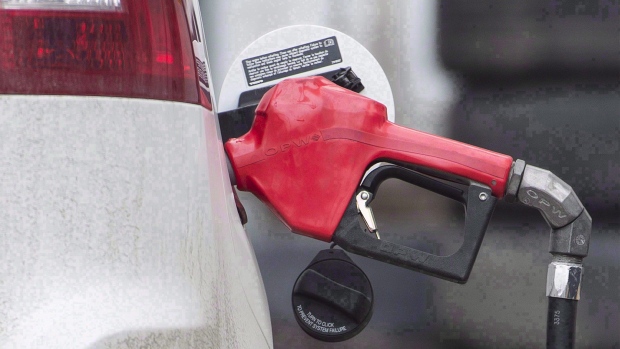
Canadians should experience the fastest drop in gasoline prices in nearly 13 years on Sunday as fears about a virulent new COVID-19 variant are expected to provide a break of 11 cents per litre at the pumps.
Dan McTeague, president of Canadians for Affordable Energy, said the national average price could drop to about $1.32 per litre but begin to rise again midweek.
“(Sunday) represents the single largest decrease at the pumps we've seen going back to 2009,” he said in an interview.
Global crude oil prices plunged Friday over fears about a new COVID-19 variant called Omicron that prompted Canada to ban entry for foreign nationals who travelled through southern Africa.
The January crude oil contract fell 13.1 per cent or US$10.24 on Friday and currently stands at US$68.15 per barrel.
The decrease came as U.S. stock markets closed early Friday because of the Thanksgiving holiday.
“Sunday and Monday are going to be the best days for Canadians to fill up, including British Columbia,” McTeague said
Even residents of flood-ravaged B.C. will save on the province's high gasoline prices despite facing rationing because severe flooding has shut both the Trans Mountain pipeline and the province's lone refinery.
Drivers of non-essential vehicles can only purchase up to 30 litres per visit to a gas station in the Lower Mainland, Sunshine Coast, Sea to Sky area, Gulf Islands and Vancouver Island.
East Coast residents won't reap the immediate benefits of Sunday's price drop because its regulated regional system averages price movements. That provides price predictability but blunts price discounts.
Despite the upcoming decrease, national gasoline prices have surged nearly 43 per cent in the past year as the reopening of the global economy from pandemic lockdowns prompted a recovery in crude prices.
McTeague suggested Canadians shouldn't get too comfortable with the energy savings. He said prices are expectd to increase as OPEC and its allies, who are meeting on Monday, will likely refuse to increase production any further. Energy traders realize that Friday's decrease was overdone and “flies in the face of fundamentals,” he added.
“My sense is that the decreases that we saw were a little exaggerated and overbought, and for that reason I think we might see a little bit more balance come back to the markets and fundamentals by Wednesday,” McTeague said.
“Unless there's further unsettling news of greater and further lockdowns, I would expect that oil prices are probably going to recover US$3 to US$4 a barrel by Monday or Tuesday, which means by Wednesday or Thursday we could be looking at increases in the order of four or five cents a litre.”
McTeague said some gasoline savings will continue for a couple of weeks, but he foresees crude climbing back to about US$90 a barrel, which would translate into prices in Canada exceeding $1.50 per litre.
Impending carbon tax increases will further boost prices.
A tax of 2.5 cents per litre, including HST, will take effect on April 1, 2022. It will be followed in December by the clear fuel standard that will add another 18.1 cents per litre including HST, said McTeague.
Adding to the inflation pressure is the Canadian dollar which is less valuable than when it was at par the last time crude prices were around US$80. That reduces the purchasing power for all kinds of products, including energy and food.
The Canadian Automobile Association said that as of early Saturday morning, Manitoba had the lowest average pump price of $1.35/L, followed closely by Alberta at $1.377, while Newfoundland and Labrador was the highest at $1.583 with British Columbia at $1.558.
This report by The Canadian Press was first published Nov. 27, 2021.
Ninety-nine new cases of COVID-19 were reported Thursday as the province began vaccinating children five to 11 years old to try to slow the spread of the virus.
In Fredericton, brothers Max and Luc Corman were the first to receive their first doses of the pediatric vaccine.
About 9,300 children have appointments booked to get vaccinated, Health Minister Dorothy Shephard told reporters at the legislature Friday morning.
"I am heartened that so many young New Brunswickers have received their first dose of vaccine and that even more have appointments to do so in the coming weeks," Dr. Jennifer Russell, chief medical officer of health, said in a statement.
To meet the demand for vaccinations, new clinics have been added in the Moncton and Fredericton region, the province said.
More than 130 pharmacies will also take part in dispensing doses of the vaccine for children, receiving shipments between Dec. 2 and Dec. 8, the province added.
More information is expected soon on when appointments at the pharmacies will become available.
Horizon Health Network has declared COVID-19 outbreaks in two units of Saint John Regional Hospital. (CBC News file photo)
Outbreaks declared at Saint John Regional Hospital
COVID-19 outbreaks have been declared in two units at the Saint John Regional Hospital, Horizon Health Network said in a news release Friday evening.
Outbreaks were declared in the orthopedic surgery (3CS) and internal medicine (4CN) units after a patient on each unit tested positive for COVID-19, communications advisor Kris McDavid said in the release.
He noted Horizon has implemented "comprehensive infection prevention and control precautions" as well as contact tracing to protect the health of patients and staff.
"Patient and staff in affected units are being tested," McDavid said. "So far, no further cases have been identified. Inpatients are being screened for COVID-19 symptoms ... every 12 hours."
There will be no patient admissions or transfers to and from these units during this time and the Designated Support Person (DSP) program will be temporarily suspended on these units.
Surgeries, labour and birth services, ambulatory care and professional services appointments will continue, McDavid said in the release.
787 active cases across province
Along with the 99 new cases of COVID on Friday, Public health reported 55 more recoveries, putting the province's active case count at 787, up from 743.
Fifty-six people are in hospital with COVID-19, including 18 in intensive care, according to the daily news release.
The one person under 19 who has hospitalized because of COVID-19 Thursday is no longer in hospital.
A total of 87.8 per cent of New Brunswickers aged 12 or older are now fully vaccinated, up from 87.7 per cent, and 93.5 per cent have received their first dose, unchanged from the last update.
New Brunswick has had 8,087 confirmed cases of COVID-19 since the beginning of the pandemic, including 7,176 recoveries and 123 COVID-related deaths.
Moncton region still leading in new cases
(CBC News)
The new cases break down this way:
Moncton region, Zone 1 — 48 cases:
19 people 19 and under
Seven people 20 to 29
10 people 30 to 39
Three people 40 to 49
Five people 50 to 59
Two people 60 to 69
Two people 70 to 79
Thirty-one are under investigation and 17 are the contacts of previously confirmed cases.
Saint John region, Zone 2 — 23 cases:
Seven people 19 and under
Three people 20 to 29
Five people 30 to 39
Two people 40 to 49
Three people 50 to 59
Two people 60 to 69
A person 70 to 79
Twelve cases are the contacts of previously confirmed cases and 11 are under investigation.
Fredericton region, Zone 3 — 15 cases:
Three people 19 and under
Three people 20 to 29
A person 30 to 39
Four people 40 to 49
Three 50 to 59
A person 60 to 69
Eight cases are under investigation and seven are the contacts of previously confirmed cases.
Campbellton region, Zone 5 — two cases:
A person 20 to 29
A person 50 to 59
Both remain under investigation.
Bathurst region, Zone 6 — three cases:
A person 19 and under
A person 40 to 49
A person 50 to 59
Two cases are contacts of previously confirmed cases and one is travel-related.
Miramichi region, Zone 7 — eight cases:
Five people 19 and under
A person 30 to 39
Two people 50 to 59.
Two cases are contacts of previously confirmed cases and six are under investigation.
More cases at the Moncton Hospital
A total of 23 patients and five staff have tested positive for COVID-19 at the Moncton Hospital as of Friday, Health Minister Dorothy Shephard says.
"All the patients effected are being tested again today and staff will be tested early next week," she said.
On Wednesday, the cases at the hospital totalled 20, including three in intensive care.
7 schools currently affected
Nine new cases of COVID-19 have been confirmed at seven schools, the COVID-19 dashboard shows.
Thirty-six schools are currently impacted.
Three schools joined the list Thursday, including Millerton Elementary and Junior High School in the Miramichi region, and Centennial School and Bayview School in the Saint John region.
The four other schools with active cases are Gretna Green School in the Miramichi region, École Le Sommet in the Monction region, Devon Middle School in the Frederiction region, and Forest Hills School in the Saint John region.
A total of 495 cases of COVID-19 have been confirmed at 141 schools since the beginning of the school year.
A case has also been confirmed at the Boys & Girls Club of Saint John After School in the Saint John region.
New cases have also been confirmed at a several previously impacted facilities including Origins Natural Learning Centre in the Saint John region, Spring Roots Early Learning and Childcare Centre inthe Fredericton region, Northend Learning Center and Causerie Amicale in the Moncton region.
"If you or a family member have been in close contact with a case, you will be notified by Public Health or the facility for contact tracing," Public Health said. "If you are not notified directly, you have not been identified as a close contact."
A total of 90 early learning child-care centres have had confirmed cases of COVID-19 since Sept. 7
New public exposure notices
Public Health shared new public exposure notices on Friday:
Saint John region, Zone 2:
Nove. 23 between 1 p.m. and 2 p.m. – Giant Tiger (100 Prince Edward St., Saint John)
Nov. 20 between 8 a.m. and 3 p.m. – Brilliant Smoke Shop (122 Lansdowne Ave., Saint John)
Nov. 20 between 11 a.m. and 1 p.m. – JJ's Diner (216 Roachville Rd., Sussex)
Nov. 18 and 19 between 2 p.m. and 10:30 p.m. – Brilliant Smoke Shop (122 Lansdowne Ave., Saint John)
Nov. 13 between 4 p.m. and 6 p.m. – Vito's (324 Rothesay Ave., Saint John)
Acadie-Bathurst region, Zone 6:
Nov. 23 between 1:30 p.m. and 2 p.m. – Atlantic Superstore (3455 Main St., Tracadie-Sheila)
Nov. 14 between 6 p.m. and 9:15 p.m. – Knights of Columbus (4293 Beauregard St., Tracadie-Sheila
People who have not been fully vaccinated at least 14 days prior to a possible exposure and who have symptoms should get a COVID lab test. They can book an appointment online or call Tele-Care 811 and must isolate while waiting for their test result.
People who are not fully vaccinated and do not have symptoms are now being instructed to pick up an At-Home COVID-19 Rapid Point of Care Test (Rapid POCT) screening kit. They do not need to isolate if they have not been directed by Public Health to do so.
All positive point-of-care test results must be confirmed with a laboratory polymerase chain reaction, or PCR, test.
It can take up to 14 days to test positive after being exposed to COVID-19, so even if results come back negative, people should continue to self-monitor for any symptoms and get tested immediately if any develop.
They should also avoid visiting settings with vulnerable populations, such as nursing homes, correctional facilities and shelters during that 14-day period.
For people who have been fully vaccinated at least 14 days prior to a possible exposure, Public Health recommends they monitor for symptoms for 14 days after the possible exposure and get a COVID lab test if symptoms develop.
They do not need to isolate while they wait for their test results.
If they do not have symptoms, they can pick up a rapid test kit and do not need to isolate.
Public Health says symptoms of the illness have included a fever above 38 C, a new or worsening cough, sore throat, runny nose, headache, a new onset of fatigue, and difficulty breathing.
In children, symptoms have also included purple markings on the fingers and toes.
People with one of those symptoms should stay at home, call 811 or their doctor and follow instructions.
Brett Bundale, The Canadian Press
Published Friday, November 26, 2021 3:37PM EST
Last Updated Friday, November 26, 2021 3:37PM EST
HALIFAX - Malls and shopping districts were bustling with shoppers in search of Black Friday discounts and a little holiday cheer, despite an abundance of sales earlier in the fall and ongoing worries over the COVID-19 pandemic.
On the East Coast, the Halifax Shopping Centre had a festive atmosphere as customers clutching shopping bags snapped photos in front of a towering Christmas tree while others watched the crowds from a cafe in the mall.
Yet the discounts were hit and miss. One shopper describing the deals as “really bad” while others emerged from the mall laden with bags and boxes of gifts.
“It's not like it normally is,” Kim McLeod said of the Black Friday sales. “We just got a couple of specific things.”
Shopper Nick Dempsey said he had already bought most of what he needed online but came to the mall to “fill in the blanks.”
“I do the majority of my holiday shopping online but I like to take advantage of Black Friday and come in and see what people are doing and what deals there are,” he said. “I'm a big fan of Christmas music and some stores play it ... it adds to the holiday spirit.”
While shoppers showed up at a Best Buy outside Halifax, it was a far cry from the hectic crowds and jammed parking lot that marked previous Black Fridays.
Shopper Alex Knights said the discounts were “pretty good” on some products.
“It depends on what you're getting,” he said. “But you can check the deals online before you come in. I found a speaker with a subwoofer and it was $100 off.”
Ian Leslie went to Best Buy to get a gift for his son.
“I could have ordered it online but now it's in my hand, so I don't have to worry about supply issues or shipping delays,” he said.
Leslie said his concerns about inventory shortages and supply chain constraints prompted him to shop early this year.
“I'm just finishing my holiday shopping today,” he said. “I did probably half online and half in stores.”
Stores have been rolling out discounts for weeks, encouraging consumers to buy early to avoid potential product shortages.
The situation has accelerated so-called Black Friday creep, a trend that started before the pandemic in which retailers try to maximize sales by pushing discounts earlier into the fall.
Retail experts say online sales are expected to remain strong this year and even grow slightly from 2020, with services like curbside pickup remaining popular.
But Anwar White with McGill University's Bensadoun School of Retail Management said many consumers will continue to shop at stores during the holidays.
“There is still something special about Black Friday and there are still people that are going to be actually going out,” he said. “But it won't be hugely driven by the sales. When you shop on Black Friday there is an energy that is unmatched and it really does say 'OK, now it's Christmastime.”'
Bradley Jones, head of retail for Oxford Properties - which owns 10 shopping centres including Square One, Yorkdale and Scarborough Town Centre in Ontario - said the holiday ambience is a big draw for shoppers.
“All of our Christmas decor is back, our safe Santa experience is set up and we have the music in the mall that puts people in the spirit,” he said. “The retailers are feeling optimism because they're seeing customers coming back.”
Suvi Rajah, who was at the Eaton Centre in downtown Toronto, said she and others are not only shopping on Black Friday because prices are better, but also because it's a tradition and people are trying to make up for last year's pandemic lockdowns that closed malls.
“I just need to get out,” she said. “Buying is … a comfort thing, not necessarily that we need the things (we buy.)”
Rajah picked up a shirt, but didn't find it more affordable than it would be on other days. However, she felt she got a good deal on makeup.
Jera Bitto, a University of Toronto student, was also at the mall, where shoppers lined up outside clothing and makeup stores.
Bitto, who tends to leave her purchases until she can find a deal, was hunting for presents for her school friends.
“Usually I don't shop. I only shop when things are cheap,” she said. “I think today is kind of cheap.”
- with files from Maan Alhmidi in Toronto
This report by The Canadian Press was first published Nov. 25, 2021.
Global stock markets and oil prices tumbled Friday after South Africa identified a new, potentially fast-spreading coronavirus variant and the European Union proposed suspending air travel from the region.
Britain promptly banned flights from South Africa and five nearby countries. Austria imposed a 10-day lockdown while Italy restricted activity by unvaccinated people. Americans were advised by their government to avoid Germany and Denmark. Belgium and Israel have already reported a handful of people who have tested positive to the new variant, and the slew of data points has added up to a flurry of uncertainty.
In New York, the Dow Jones Industrial Average lost more than 2.5 per cent, its biggest decline in more than a year, to close at 34,899. In Toronto, the TSX Composite Index lost almost 500 points or, 2.25 per cent, to finish the day at 21,125.
"This news has completely overshadowed early anecdotal reports of strong in-person and online traffic for Black Friday sales," said Colin Cieszynski with SIA Wealth Management in Toronto.
Friday would normally be a quiet day on U.S. stock markets because of the Thanksgiving holiday on Thursday, as stock markets in New York are scheduled to close at 1 p.m.
Oil and travel companies hit hardest
That thin trading could potentially make market anxieties worse as there is a smaller pool of buyers and sellers available to offset outliers.
"What you're seeing is the absence of a lot of active managers in the U.S. and a lot of concerned panic selling … around the world," said Dennis Mitchell, CEO of Starlight Capital, in an interview.
The VIX — which is known as Wall Street's "fear index" because it measures volatility — spiked by more than 40 per cent to above 26 points. That's its highest level since January 2021, before vaccination campaigns started to ramp up.
Anything related to energy or travel and tourism is being hit especially hard as investors digest the prospect of another round of limitations on international travel.
The North American benchmark oil price known as West Texas Intermediate lost more than $10 US to close at just over $68 a barrel. That's the worst one-day performance for oil since the price briefly plummeted below zero in April 2020.
Jeremy McCrea, managing director at Raymond James Energy Research, says while the anxiety is real, some of the oil selling is coming from traders just locking in profits from the recent run while they can.
"Given how much oil prices have moved up … there's a lot of profit taking, a lot of speculators saying, 'I'm not quite sure what this really means,' " he said in an interview.
Oil prices plunged Friday on news of the spread of a new, possibly more transmissible COVID-19 variant. (Todd Korol/Reuters)
"Wait a couple of weeks until we get a better idea of what this actually means."
With fears now of a new variant that could curb global demand for oil, he said it shows there are "still a lot of big factors that can shift prices here quite a bit."
Air Canada shares lost more than eight per cent while those of cruise line Carnival lost 11. Hotel chains Hilton and Marriott were both down by more than six per cent.
"These announcements have sparked a sell-off in travel-related stocks (airlines, cruise lines, hotels etc.) and has sparked a rally in stay-at-home and vaccine stocks," Cieszynski said.
Pfizer shares rose nearly seven per cent while Moderna shares jumped more than 22 per cent.
"Today's price action and abrupt moves were a good reminder of a need to avoid virus complacency into 2022," currency analyst Audrey Childe-Freeman with Bloomberg Intelligence said in a note to clients.
Lisa Kramer, a professor of finance at the Rotman School of Management in Toronto, says investors are reacting with a fear similar to what happened at the start of the pandemic.
"It isn't uncommon when we have dramatic news come out for some people to overreact," she said in an interview. "And it doesn't take a lot of people panicking for markets to react strongly."
Cryptocurrencies sold off heavily as investors ran toward things like gold, bonds and the U.S. dollar that are perceived to be safer stores of value.
"In times like this, we get a true sense of what investors consider to be real, reliable safe havens and bitcoin is off eight per cent today, which has delivered a fatal blow to its safe-haven credentials, putting an end to another crypto myth that has surfaced over the years despite there being zero evidence to back it up," analyst Craig Erlam with foreign exchange firm Oanda said.
The emergence of the new strain represents the biggest threat to the recovery in global oil consumption.
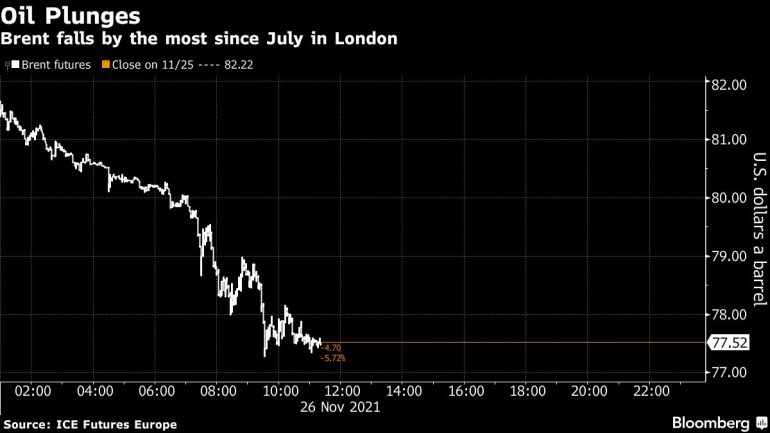
Oil prices crashed more than 10% as a new coronavirus strain sparked fears that renewed lockdowns will threaten a global recovery in demand.
West Texas Intermediate crude tumbled below the $70-a-barrel level on Friday for the first time since late September, while the global benchmark price, Brent, slumped to less than $75.
The downward spiral in prices comes three days after a U.S.-led effort by top consuming nations to release stockpiled crude in an attempt to tame surging energy inflation. Next week’s OPEC+ meeting will now take on an even greater significance, as the producer group led by Saudi Arabia and Russia must decide whether to continue ratcheting up supply or pause the increases in response to the latest market volatility. OPEC+ is leaning toward abandoning a plan for a modest production hike scheduled for January when it meets on Dec. 1 to 2, according to delegates.
The identification of the new Covid variant has already prompted the U.S., the European Union and the U.K. to restrict air travel and triggered a selloff across financial markets, even as researchers have yet to determine whether it’s more transmissible or lethal than previous strains.
The development apparently wrong-footed many in the oil market who had been comforted by low inventory levels and demand that had rebounded to 2019 levels, said Rebecca Babin, senior energy trader at CIBC Private Wealth Management.
“It was a lack of downside that had us continuing to think nothing bad could happen,” she said. “No one was thinking we could get a variant that we’re not familiar with and it could have meaningful impact.”
The price plunge marks a dramatic change in market sentiment. Crude hit multiyear highs in recent months amid an energy crisis in Europe and China that had also sparked rallies in prices for coal and natural gas. Some traders and analysts predicted oil could reach $100 a barrel or more.
High gasoline retail prices prompted U.S. President Joe Biden to seek ways to ease the pressure on consumers, leading to Tuesday’s announcement that the U.S. will release 50 million barrels of crude from the Strategic Petroleum Reserve, with China, Japan, India, South Korea and the U.K. also set to tap inventories. Still, oil rose on the day that the move was confirmed, suggesting traders had already priced in the new supply, or that they were underwhelmed by the supply response.
OPEC+ had warned previously it would reconsider a potential output increase if other nations went ahead with a reserve release. UBS Group AG said Friday that OPEC+ could choose to pause its current planned output hike of 400,000 barrels a day, or even cut production.
Prices
West Texas Intermediate for January fell $10.24, or 13.1%, from Wednesday’s close to settle at $68.15 a barrel in New York. The decline was the largest since April 2020.
There was no settlement Thursday due to the Thanksgiving holiday and all transactions will be booked Friday
Brent for January settlement tumbled $9.50 to settle at $72.72 a barrel on the ICE Futures Europe exchange
Friday’s oil selloff was likely exacerbated by a lack of trading activity during the U.S. holiday period, coming a day after Thanksgiving, and as the New York market closed early.
“It’s a sign the market got carried away from itself and that we still remain very vulnerable to Covid-19,” said John Kilduff, founding partner at Again Capital LLC.
Aside from the headline prices, crude traders also watched several other notable shifts in the market. WTI crude futures closed below its 200-day and 100-day moving averages, signs of technical weakness. The extreme pressure on the U.S. benchmark meant its discount to Brent expanded, reaching the widest since May 2020.
The picture wasn’t much brighter in oil-product markets, the part of the oil complex most directly affected by end-user demand. Diesel plunged, particularly in Asia, as the market began to price in a potential renewed hit to economic growth.
“This is a huge overreaction in terms of the market,” Amrita Sen, chief oil analyst at consultant Energy Aspects Ltd. said in a Bloomberg Television interview. “This is the market pricing in the worst possible scenarios.”
Other key news:
China’s ambiguity on whether it will join the U.S.-led coordinated release of oil reserves is aimed at a domestic audience to show Beijing isn’t following Washington, according to government officials involved in the discussions.
Global stock markets and oil prices tumbled Friday after South Africa identified a new, fast-spreading coronavirus variant and the European Union proposed suspending air travel from the region.
Britain promptly banned flights from South Africa and five nearby countries. Austria imposed a 10-day lockdown while Italy restricted activity by unvaccinated people. Americans were advised by their government to avoid Germany and Denmark. Belgium and Israel have already reported a handful of people who have tested positive to the new variant, and the slew of data points has added up to a flurry of uncertainty.
The Dow Jones Industrial Average, the S&P 500 and the TSX Composite Index were sharply down in premarket trading and held those losses into the trading day. Nearing midday, all three were down by about two per cent.
"This news has completely overshadowed early anecdotal reports of strong in-person and online traffic for Black Friday sales," said Colin Cieszynski with SIA Wealth Management in Toronto.
Friday would normally be a quiet day on U.S. stock markets because of the Thanksgiving holiday on Thursday, as stock markets in New York are scheduled to close at 1 p.m.
Oil and travel companies hit hardest
That thin trading could potentially make market anxieties worse as there is a smaller pool of buyers and sellers available to offset outliers.
The VIX — which is known as Wall Street's "fear index" because it measures volatility — spiked by more than 40 per cent to above 26 points. That's its highest level since January 2021, before vaccination campaigns started to ramp up.
Anything related to energy or travel and tourism is being hit especially hard as investors digest the prospect of another round of limitations on international travel.
The North American benchmark oil price known as West Texas Intermediate lost more than $9 US, or more than 12 per cent, to trade just below $70 US a barrel.
Air Canada shares lost more than eight per cent while those of cruise line Carnival lost 11. Hotel chains Hilton and Marriott were both down by more than eight per cent.
"These announcements have sparked a sell-off in travel-related stocks (airlines, cruise lines, hotels etc.) and has sparked a rally in stay-at-home and vaccine stocks," Cieszynski said.
Pfizer shares rose nearly seven per cent while Moderna shares jumped more than 22 per cent.
"Today's price action and abrupt moves were a good reminder of a need to avoid virus complacency into 2022," currency analyst Audrey Childe-Freeman with Bloomberg Intelligence said in a note to clients.
Cryptocurrencies sold off heavily as investors ran toward things like gold, bonds and the U.S. dollar that are perceived to be safer stores of value.
"In times like this, we get a true sense of what investors consider to be real, reliable safe havens and bitcoin is off eight per cent today, which has delivered a fatal blow to its safe-haven credentials, putting an end to another crypto myth that has surfaced over the years despite there being zero evidence to back it up," analyst Craig Erlam with foreign exchange firm Oanda said.