There are now 731 people hospitalized in the province with 617 in the ICU. Hospitalizations are down more than 250 since one week ago and ICU numbers have reached the lowest mark since April 11.
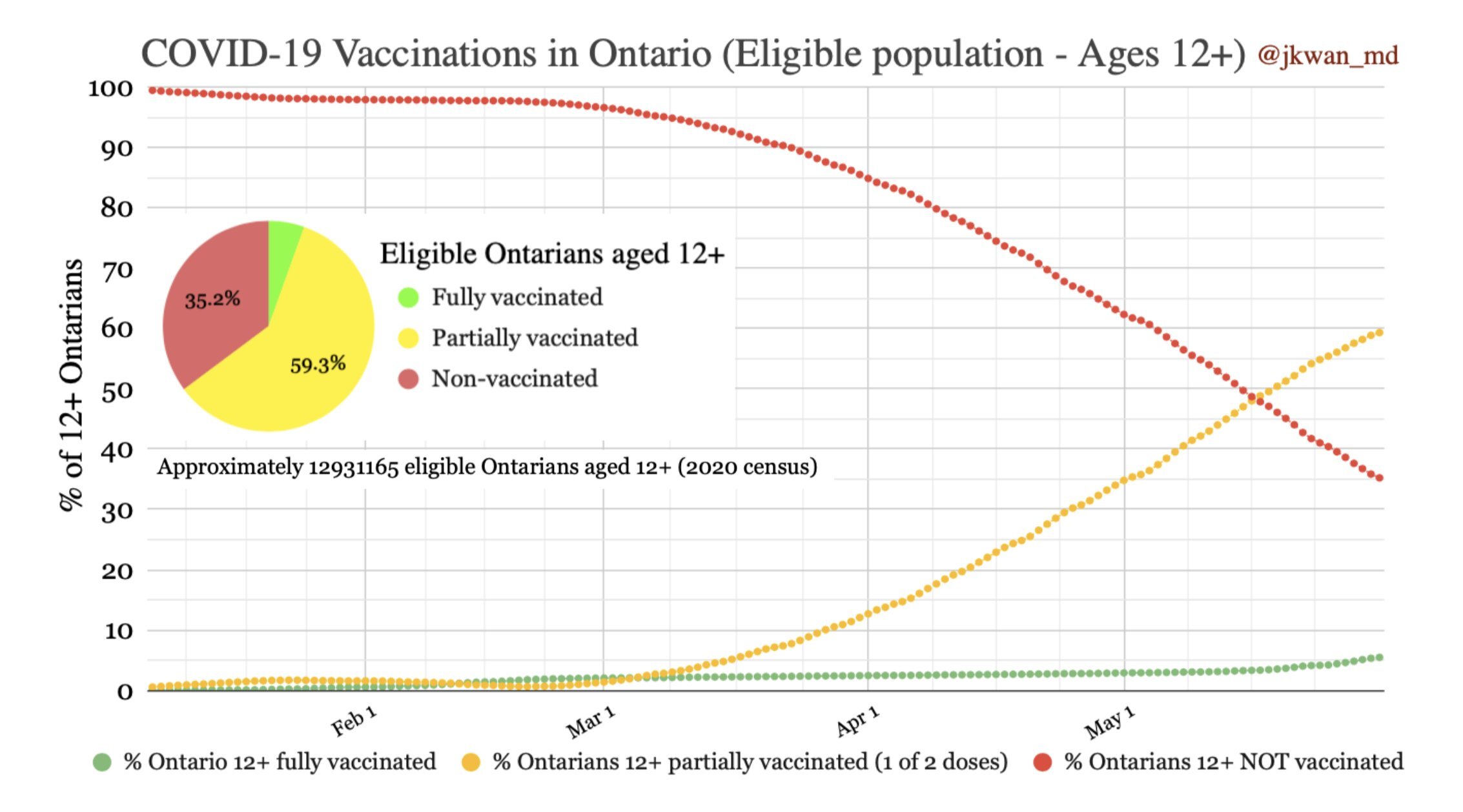
There were 97,747 COVID-19 vaccine doses administered in the last 24-hour period.
As of 8:00 p.m. Sunday, 9,082,025 doses have been administered across the province.
The government announced last week that it would shorten the minimum interval for COVID-19 vaccine doses to just four weeks, starting with those 80 and older this week.
The accelerated second dose plan aims to have the majority of Ontario residents who choose to get the vaccine be fully vaccinated by the end of summer.
Moore currently serves as the top doctor at the Kingston-area public health unit, and is expected to take over as Ontario’s chief medical officer of health on June 26.
The announcement of Williams’ departure comes as a reluctant Ford struggles with whether to send children back to school for the final weeks of the academic year. Williams, along with most of his counterparts, has said classes could resume safely.
In a statement, Premier Doug Ford says the decision was made after discussion with the chief medical officer health, Toronto Public Health and hospital partners. Ford says the health care workers invited will include hospital and long-term care staff.
With more than 40 years of experience, Love Dodd of Victoria thought he had seen everything the furniture business could throw at him.
But even he almost jumped out of his chair when he saw the size of new tariffs that were slapped on a lot of his merchandise earlier this month.
"We personally got hit with a couple of hundred thousand dollars," he said in an interview. "That's been a huge blow for us."
On May 5, the federal government imposed tariffs of up to 295 per cent on imported upholstered furniture from Vietnam and China. With three furniture stores across Vancouver Island, Dodd says the impact on his business, which employs roughly 80 people, was almost immediate.
He recalls a customer who came into one of his stores recently and tested out a recliner that was priced at $698. "If they come to my store today, it's going to be $2,598," he said. "It's not affordable."
Ottawa imposed tariffs after a half dozen Canadian furniture producers complained that products from Vietnam and China were being dumped into Canada at prices that were wildly uncompetitive.
Protectionist policy
Winnipeg-based Palliser Furniture is the company that got the process started. While it declined an interview request, the manufacturer's letters to government officials lay out its reasoning. According to government data, roughly $475 million worth of upholstered sofas and chairs subject to the new tariffs get imported into Canada every year, the majority of which come from China.
Palliser says less than 20 years ago, Canadian manufacturers produced well over half of those items sold in Canada. Today, it's barely one-sixth.
According to Palliser, the flood of cheap products, primarily from China, is hurting Canadian companies. "There has been a significant loss of jobs across Canada as a result of the unfair competition from China in particular," one of the company's submissions to the Canada Border Services Agency says.
Love Dodd runs Dodd's Furniture, a chain of home furnishings stores with three locations across Vancouver Island, employing about 80 people. He says the federal government's tariffs on upholstered furniture imported from China and Vietnam are hurting his business. (David Malysheff/CBC)
Exporting items at prices below what they would sell for domestically is known as dumping, and it's a contentious issue in international trade law.
Unpopular though they may be with consumers, tariffs are one of the bluntest instruments available to governments seeking to level the playing field.
Complaints about unfairly priced Chinese and Vietnamese-made products have been a long simmering issue in the furniture business, so while Dodd says he had an inkling something was coming, he was expecting tariffs in the range of 10 to 20 per cent, similar to what the U.S. recently implemented.
But at four times the sticker price for some products, sales have slowed to a crawl as customers balk at exorbitant hikes, he said. While about half his upholstered merchandise is locally sourced, the other half has been waylaid by the tariffs.
"If we can't sustain delivering product to our customers and having merchandise for them, we don't have sales," he said. "We probably have to downsize our operations."
The tariffs imposed so far are preliminary, which means they can be raised, lowered or removed altogether when the government finishes its investigation into the matter later this summer. But it's clear the government already thinks dumping is an issue.
"Canada Border Services Agency is of the opinion that there is evidence that [furniture] originating in or exported from China and Vietnam have been dumped and subsidized," CBSA said in explaining the decision. "[And] there is evidence that discloses a reasonable indication that such dumping and subsidizing have caused and are threatening to cause injury to the Canadian domestic industry."
Cascading impact
On top of dwindling sales, Dodd is facing a slew of customers cancelling orders because they have to pay higher prices since the items they've ordered haven't been imported yet and will be subject to the tariffs.He's already out thousands of dollars in tariff costs he'll have to pay for items that are already on their way to Canada, he said.
But he's trying to minimize the financial hit by stopping any more shipments unless he's sure he can sell the items at the higher price.
"I've cancelled almost 35 containers of product coming until the end of the year," he said. "That's $1 million of sales."
Dodd says the industry needs access to mass-produced goods from overseas in order to offset more limited Canadian production, but some local manufacturers disagree.
Dino Colalillo, the owner of Edgewood Furniture in Woodbridge, Ont., says he's glad the government has finally stepped in to help manufacturers like him.
"It's justified, maybe 10 years too late," he said in an interview.
He said Canada's domestic furniture manufacturing industry is a shadow of what it once was because manufacturers in China, Vietnam and elsewhere have been flooding the market with mass-produced goods with costs subsidized by their local governments.
"A lot of the places just gave up and closed," he said of Canada's industry.
According to Statistics Canada, as recently as 2017, Canadians bought about $148 million worth of upholstered couches and chairs made in Canada. Last year, that figure dropped to just $115 million.
WATCH | Furniture maker explains how foreign products undercut competition:
Edgewood Furniture owner Dino Colalillo says it's hard to compete when Chinese made furniture is being dumped into Canada at a retail price that doesn't even cover his cost of raw materials. Photo: Craig Chivers/CBC 0:40
Colalillo said most of the manufacturers that still exist have differentiated themselves by offering more customization in terms of fabrics and different colours, because they can't compete with mass-produced foreign items.
"For the industry, it's good," he said of the tariffs. "It kind of pushes retailers to try to buy more Canadian."
"I applaud the government for actually doing something about it, finally. I just hope it sticks."
But Melissa and Sacha Leclair, owners of Ottawa furniture boutique LD Shoppe, say they wish the government had also considered the impact on consumers and retailers, instead of just manufacturers.
The Leclairs work hard to source locally, they said, so only about 10 to 15 per cent of their products have been impacted by the tariffs, mostly very specific products with a style that they can't find a domestic supplier for.
"There's a really small number of manufacturers in Canada producing anything similar," said Sacha, the company's president and creative director. "There's no options really to make it domestically."
A look at LD Shoppe's catalog underscores just how drastic the impact can be. The bestselling item is the Darcy Swivel Chair, which retails for $1,419. But a note on that item's page on the website warns customers the chair now comes with a tariff of $1,351 — nearly doubling the price.
WATCH | Tariff plan needs tweaking, Ottawa boutique says:
Melissa and Sacha Leclair, who own Ottawa-based LD Shoppe, say the new tariff plan needs a rethink to consider the impact on retailers as well as the manufacturing side of things. 0:29
It's disheartening to have to walk through the showroom and remove items so as not to mislead customers, because "that's now an unsellable good," said Melissa, the company's CEO.
"To do this to small businesses in the middle of a pandemic, when our stores already closed in lockdown," Sacha said, "it just felt like kicking us while we're down."
Things may change
Mark Warner, a trade lawyer with MAAW Law in Toronto, says that while tariffs of up to 295 per cent are doubtless hard to swallow, Canada is not like other countries when it comes to trade disputes because there's a section in Canadian law that allows the government to consider what's in the public interest with regard to actually implementing remedies in trade disputes.
"It will be interesting to watch to see first if these preliminary duties stand up ... and, secondly, whether some group of aggrieved consumers decides to launch a public interest [argument]," he said.
In that case, he said, it's possible the government determines it's not in the public interest, in the middle of a pandemic, "to force Canadian consumers to pay 300 per cent more for a couch."
If the price hike isn't enough of a deterrent, Love Dodd says the tariffs also come with another potential shock for any Canadians shopping for furniture right now.
"With made-in-Canada product, we're seeing up to a one-year wait right now," he said.
"You're going to see a lot of stores that are half empty."
An Amazon employee says working at the distribution giant's Ottawa warehouse during the pandemic has been a nerve-racking experience, citing examples of safety measures that were allegedly ignored and dozens of workers who have been tested positive for COVID-19.
The employee, who tested positive for the virus in late 2020, is one of 500 people who work at Amazon's distribution centre in Ottawa's rural east end. CBC News has agreed to protect the source's identity because they fear losing their job for speaking to the media.
Since the pandemic began, the employee says demand at the warehouse has grown, placing more pressure on workers to avoid safety protocols, particularly with regard to physical distancing.
The fear of getting COVID was very real. I was terrified of it and I was terrified of giving it to my partner.- Employee at Amazon's east Ottawa distribution centre
"You know, working closer together, you have to lift more heavy things together.... Not everybody wears a mask properly," said the worker, who has shown CBC photos taken from inside the warehouse.
In one photo, an employee's mask is resting below his mouth. In another, two employees are sitting close together.
Amazon employees aren't represented by a union. The worker said many have been too afraid to speak to management about making changes for fear of losing their jobs.
"Since the whole thing began, it's been kind of nerve-racking for me," they said.
An Amazon employee at the Ottawa warehouse says working conditions have been precarious during the pandemic, with dozens of workers testing positive for COVID-19. CBC News has agreed to protect the source's identity because they fear losing their job. 1:06
The three closures were ordered under Section 22 of Ontario's Health Protection and Promotion Act. Peel's public health unit said it will close workplaces that have five or more cases over two weeks, saying the shutdowns are designed to protect employees, their families and the wider community.
But here in Ottawa, the employee said Amazon has not shut down the warehouse once, even after reporting multiple cases within the span of a few days.
A dozen COVID-19 alerts in January
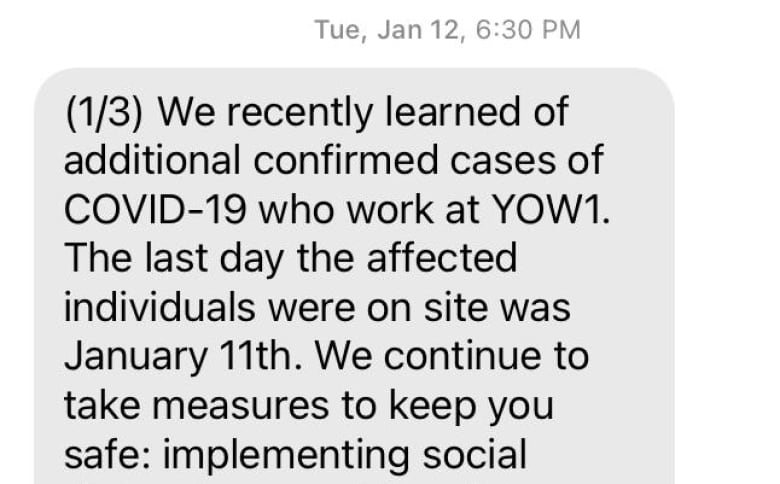
Amazon sends a text alert to employees when someone in the warehouse tests positive for COVID-19. CBC was shown 35 text alerts, some reporting multiple cases in this Ottawa warehouse, sent between April 2020 and March 2021.
A dozen alerts were sent in January alone, during what is considered the province's third wave. Several were for more than a single case.
An example of a text sent to employees at Ottawa's Amazon warehouse, alerting them of new confirmed cases of COVID-19. Dozens have been sent to employees since April 2020. (Submitted by Amazon employee)
Ottawa Public Health (OPH) declined to confirm the 35 cases because it does not publicly identify businesses where outbreaks occur. But according to the health authority's COVID-19 dashboard, there have been at least nine outbreaks in warehouses across the city, with 54 total positive cases in January.
OPH told CBC positive cases do not always amount to what it defines as an outbreak, so won't always be listed on its dashboard.
Details of the alleged unsafe work conditions are not surprising to Gagandeep Kaur, an organizer at the Warehouse Workers Centre, which advocates for Amazon employees.
Kaur said warehouse jobs tend to be low-paying and lack job security, and the people who work there often come from immigrant communities where good jobs are hard to come by. She said even before the pandemic those workplaces had safety issues.
But the pandemic has pushed demand for online products, which in turn has pushed workers to produce more. Amazon, she said, "is known for pushing workers beyond their limits, beyond their physical limits."
Amazon focusing on 'communicating transparently'
Amazon would not say how many employees at the east Ottawa centre have tested positive since March 2020, saying in a statement to CBC that "site-specific case figures lack a significant amount of context."
The company said it instead focuses on "communicating transparently to local health authorities and ... to employees whenever there is a new case."
When asked why it hasn't shut down this warehouse after employees tested positive, Amazon said it works closely with OPH when new cases come up, but that "we have not had a reason to — or have been directed to — consider any other action than continuing to invest in and maintain our safety procedures."
For its part, OPH said "all workplaces to date have complied with IPAC [Infection Prevention and Control] recommendations and closed voluntarily if required without the use of legal action."
Gagandeep Kaur, who advocates for Amazon employees, is calling on public health agencies and governments to put pressure on the company to protect its employees from COVID-19 transmission in its warehouses. 0:52
The public health agency said decisions to close a workplace depend on several factors, including the level of risk to the public, the nature of the work or business, and compliance with case and contact-tracing investigations.
In its statement to CBC, an Amazon spokesperson said "nothing's more important" than employees' health and safety, and the company is doing everything it can to support them.
Though Amazon didn't say what measures were in place at the east Ottawa centre, the spokesperson said the company has invested $11.5 billion worldwide in safety measures, including "masks, temperature screening, plexiglass shields, sanitizing products, additional cleaning teams, and even an on-site testing program."
The company has a strict zero-tolerance policy for anyone violating COVID-19 procedures, which are enforced on every shift, the statement read.
'I was terrified of it'
That wasn't the experience of the employee CBC spoke with, however. The employee said at one point they took a leave of absence "because I didn't feel safe enough to work in the place," but ended up testing positive for COVID-19 in the fall and in turn infected their partner.
"The fear of getting COVID was very real. I was terrified of it and I was terrified of giving it to my partner, and then we ended up getting COVID anyway."
The whistleblower is hoping the company changes its policies to shut down the workplace if employees test positive for COVID-19, and offer paid leave for those waiting for a test result.
Kaur said if Amazon won't choose to close down its warehouses after positive outbreaks, OPH needs to follow Peel's lead and step in.
"These are the workers who have supported us all through this crisis, risking their lives every single day to fulfil the needs of the rest of the society. I think as a society we owe them, and government must do something."
OTTAWA --
Canada is set to receive 2.9 million COVID-19 vaccine doses this week thanks in large part to an increase in planned deliveries from Pfizer and BioNTech.
The two pharmaceutical companies had been delivering about 2 million shots per week through the month of May, but will increase that to 2.4 million doses per week starting on Monday.
The federal government says the other 500,000 shots due to arrive this week will come from Moderna, which will deliver the jabs in two separate shipments.
The first will arrive in the middle of the week while the second is due for delivery next weekend, with the doses set for distribution to provinces and territories next week.
The government is also expecting another 1 million doses of the Oxford-AstraZeneca vaccine by the end of June, though a detailed delivery schedule has not been confirmed.
The fate of more than 300,000 shots from Johnson and Johnson that were first delivered in April remains unclear as Health Canada continues reviewing their safety following concerns about possible tainting at a Baltimore production facility.
The arrival of more Pfizer-BioNTech and Moderna shots comes after Health Canada's Saturday decision to extend the expiry date of tens of thousands of AstraZeneca doses by one month. Many Canadians had been scrambling to get a second shot before the original best-by date of May 31.
The department stressed in a statement that the move was supported by ample scientific evidence.
News of the extension came as pharmacists and physicians in Ontario planned to work through the weekend to use up 45,000 shots expiring on May 31 and 10,000 more with a best-before date in June.
Any injections formerly set to expire on Monday can now be used until July 1, according to Health Canada's new guidance.
Some provinces have paused their use of the vaccine over supply issues and concerns around a rare but deadly blood clotting disorder linked to the shots.
There were just over two dozen confirmed cases of vaccine-induced immune thrombotic thrombocytopenia, also known as VITT, in Canada as of last Thursday, with another 14 under investigation.
Five people had died of the condition, the Public Health Agency of Canada said.
Ontario resumed the use of the AstraZeneca vaccine for second doses this past week, citing evidence that the likelihood of developing the condition is even lower after the follow-up shot than it is after the first injection.
As of Sunday night, provinces reported administering more than 23 million doses, with more than half the population having received at least one shot. Nearly 2 million Canadians, or about five per cent of the population, have been fully vaccinated.
This report by The Canadian Press was first published May 31, 2021.
With more than 40 years of experience, Love Dodd of Victoria thought he had seen everything the furniture business could throw at him.
But even he almost jumped out of his chair when he saw the size of new tariffs that were slapped on a lot of his merchandise earlier this month.
"We personally got hit with a couple of hundred thousand dollars," he said in an interview. "That's been a huge blow for us."
On May 5, the federal government imposed tariffs of up to 295 per cent on imported upholstered furniture from Vietnam and China. With three furniture stores across Vancouver Island, Dodd says the impact on his business, which employs roughly 80 people, was almost immediate.
He recalls a customer who came into one of his stores recently and tested out a recliner that was priced at $698. "If they come to my store today, it's going to be $2,598," he said. "It's not affordable."
Ottawa imposed tariffs after a half dozen Canadian furniture producers complained that products from Vietnam and China were being dumped into Canada at prices that were wildly uncompetitive.
Protectionist policy
Winnipeg-based Palliser Furniture is the company that got the process started. While it declined an interview request, the manufacturer's letters to government officials lay out its reasoning. According to government data, roughly $475 million worth of upholstered sofas and chairs subject to the new tariffs get imported into Canada every year, the majority of which come from China.
Palliser says less than 20 years ago, Canadian manufacturers produced well over half of those items sold in Canada. Today, it's barely one-sixth.
According to Palliser, the flood of cheap products, primarily from China, is hurting Canadian companies. "There has been a significant loss of jobs across Canada as a result of the unfair competition from China in particular," one of the company's submissions to the Canada Border Services Agency says.
Love Dodd runs Dodd's Furniture, a chain of home furnishings stores with three locations across Vancouver Island, employing about 80 people. He says the federal government's tariffs on upholstered furniture imported from China and Vietnam are hurting his business. (David Malysheff/CBC)
Exporting items at prices below what they cost to produce is known as dumping, and it's a contentious issue in international trade law.
Unpopular though they may be with consumers, tariffs are one of the bluntest instruments available to governments seeking to level the playing field.
Complaints about unfairly priced Chinese and Vietnamese-made products have been a long simmering issue in the furniture business, so while Dodd says he had an inkling something was coming, he was expecting tariffs in the range of 10 to 20 per cent, similar to what the U.S. recently implemented.
But at four times the sticker price for some products, sales have slowed to a crawl as customers balk at exorbitant hikes, he said. While about half his upholstered merchandise is locally sourced, the other half has been waylaid by the tariffs.
"If we can't sustain delivering product to our customers and having merchandise for them, we don't have sales," he said. "We probably have to downsize our operations."
The tariffs imposed so far are preliminary, which means they can be raised, lowered or removed altogether when the government finishes its investigation into the matter later this summer. But it's clear the government already thinks dumping is an issue.
"Canada Border Services Agency is of the opinion that there is evidence that [furniture] originating in or exported from China and Vietnam have been dumped and subsidized," CBSA said in explaining the decision. "[And] there is evidence that discloses a reasonable indication that such dumping and subsidizing have caused and are threatening to cause injury to the Canadian domestic industry."
Cascading impact
On top of dwindling sales, Dodd is facing a slew of customers cancelling orders because they have to pay higher prices since the items they've ordered haven't been imported yet and will be subject to the tariffs.He's already out thousands of dollars in tariff costs he'll have to pay for items that are already on their way to Canada, he said.
But he's trying to minimize the financial hit by stopping any more shipments unless he's sure he can sell the items at the higher price.
"I've cancelled almost 35 containers of product coming until the end of the year," he said. "That's $1 million of sales."
Dodd says the industry needs access to mass-produced goods from overseas in order to offset more limited Canadian production, but some local manufacturers disagree.
Dino Colalillo, the owner of Edgewood Furniture in Woodbridge, Ont., says he's glad the government has finally stepped in to help manufacturers like him.
"It's justified, maybe 10 years too late," he said in an interview.
He said Canada's domestic furniture manufacturing industry is a shadow of what it once was because manufacturers in China, Vietnam and elsewhere have been flooding the market with mass-produced goods with costs subsidized by their local governments.
"A lot of the places just gave up and closed," he said of Canada's industry.
According to Statistics Canada, as recently as 2017, Canadians bought about $148 million worth of upholstered couches and chairs made in Canada. Last year, that figure dropped to just $115 million.
WATCH | Furniture maker explains how foreign products undercut competition:
Edgewood Furniture owner Dino Colalillo says it's hard to compete when Chinese made furniture is being dumped into Canada at a retail price that doesn't even cover his cost of raw materials. Photo: Craig Chivers/CBC 0:40
Colalillo said most of the manufacturers that still exist have differentiated themselves by offering more customization in terms of fabrics and different colours, because they can't compete with mass-produced foreign items.
"For the industry, it's good," he said of the tariffs. "It kind of pushes retailers to try to buy more Canadian."
"I applaud the government for actually doing something about it, finally. I just hope it sticks."
But Melissa and Sacha Leclair, owners of Ottawa furniture boutique LD Shoppe, say they wish the government had also considered the impact on consumers and retailers, instead of just manufacturers.
The Leclairs work hard to source locally, they said, so only about 10 to 15 per cent of their products have been impacted by the tariffs, mostly very specific products with a style that they can't find a domestic supplier for.
"There's a really small number of manufacturers in Canada producing anything similar," said Sacha, the company's president and creative director. "There's no options really to make it domestically."
A look at LD Shoppe's catalog underscores just how drastic the impact can be. The bestselling item is the Darcy Swivel Chair, which retails for $1,419. But a note on that item's page on the website warns customers the chair now comes with a tariff of $1,351 — nearly doubling the price.
WATCH | Tariff plan needs tweaking, Ottawa boutique says:
Melissa and Sacha Leclair, who own Ottawa-based LD Shoppe, say the new tariff plan needs a rethink to consider the impact on retailers as well as the manufacturing side of things. 0:29
It's disheartening to have to walk through the showroom and remove items so as not to mislead customers, because "that's now an unsellable good," said Melissa, the company's CEO.
"To do this to small businesses in the middle of a pandemic, when our stores already closed in lockdown," Sacha said, "it just felt like kicking us while we're down."
Things may change
Mark Warner, a trade lawyer with MAAW Law in Toronto, says that while tariffs of up to 295 per cent are doubtless hard to swallow, Canada is not like other countries when it comes to trade disputes. The government is required by law to consider what's in the public interest with regard to actually implementing remedies.
"It will be interesting to watch to see first if these preliminary duties stand up ... and, secondly, whether some group of aggrieved consumers decides to launch a public interest [argument]," he said.
In that case, he said, it's possible the government determines it's not in the public interest, in the middle of a pandemic, "to force Canadian consumers to pay 300 per cent more for a couch."
If the price hike isn't enough of a deterrent, Love Dodd says the tariffs also come with another potential shock for any Canadians shopping for furniture right now.
"With made-in-Canada product, we're seeing up to a one-year wait right now," he said.
"You're going to see a lot of stores that are half empty."