McDonald's Canada says it will start importing beef as Canada's beef supply chain struggles to meet current demand amid COVID-19.
The restaurant chain, which prides itself on using only Canadian beef, says in a statement that its change in policy is due to limited processing capacity at Canadian suppliers, such as a Cargill Inc. plant near High River, Alta.
A woman wearing face mask walks on the ocean front while Oil tankers are seen anchored off the coast of Long Beach, California, after sunset on April 25, 2020.
Apu Gomes | AFP | Getty Images
Oil prices jumped in the afternoon of Asian trading hours on Wednesday following a report that showed a smaller than expected crude inventory build stateside.
The moves came after data from the American Petroleum Institute showed Tuesday that U.S. crude inventories jumped by 10 million barrels in the week to April 24 — to 510 million barrels, according to Reuters. That was lower than analysts' expectations of a build of 10.6 million barrels, Reuters reported.
Still, in a note dated April 28, Moody's Investors Service said it was reducing its near-term oil price assumptions for WTI as well as Brent.
"Exceptionally weak short-term prices will persist until production drops enough to ease the strain on storage facilities already operating at or close to full capacity," said Elena Nadtotchi, vice president and senior credit officer at Moody's. "Significant supply adjustments in due course should help to balance the market later in 2020, but the pace of the market's rebalancing and rising oil prices will depend on demand recovery."
Moody's price prediction for WTI is currently $30 per barrel this year, and $40 next year. For Brent, it sees prices averaging $35 per barrel in 2020 and $45 in 2021.
Oil prices swayed wildly on Tuesday between gains and losses as investors continue to keep an eye on depleting crude storage space amid a dearth in demand. The coronavirus pandemic, which has forced countries around the world to shut down their economies temporarily as people are told to stay home, has also effectively frozen major economies globally.
WTI for June delivery fell 4 cents, or 3.4%, to settle at $12.34 per barrel on Tuesday. International benchmark Brent crude, on the other hand, gained 47 cents, or 2.35%, to settle at $20.46.
— CNBC's Pippa Stevens and Sam Meredith contributed to this report.
A woman wearing face mask walks on the ocean front while Oil tankers are seen anchored off the coast of Long Beach, California, after sunset on April 25, 2020.
Apu Gomes | AFP | Getty Images
Oil prices jumped in the afternoon of Asian trading hours on Wednesday following a report that showed a smaller than expected crude inventory build stateside.
The moves came after data from the American Petroleum Institute showed Tuesday that U.S. crude inventories jumped by 10 million barrels in the week to April 24 — to 510 million barrels, according to Reuters. That was lower than analysts' expectations of a build of 10.6 million barrels, Reuters reported.
Still, in a note dated April 28, Moody's Investors Service said it was reducing its near-term oil price assumptions for WTI as well as Brent.
"Exceptionally weak short-term prices will persist until production drops enough to ease the strain on storage facilities already operating at or close to full capacity," said Elena Nadtotchi, vice president and senior credit officer at Moody's. "Significant supply adjustments in due course should help to balance the market later in 2020, but the pace of the market's rebalancing and rising oil prices will depend on demand recovery."
Moody's price prediction for WTI is currently $30 per barrel this year, and $40 next year. For Brent, it sees prices averaging $35 per barrel in 2020 and $45 in 2021.
Oil prices swayed wildly on Tuesday between gains and losses as investors continue to keep an eye on depleting crude storage space amid a dearth in demand. The coronavirus pandemic, which has forced countries around the world to shut down their economies temporarily as people are told to stay home, has also effectively frozen major economies globally.
WTI for June delivery fell 4 cents, or 3.4%, to settle at $12.34 per barrel on Tuesday. International benchmark Brent crude, on the other hand, gained 47 cents, or 2.35%, to settle at $20.46.
— CNBC's Pippa Stevens and Sam Meredith contributed to this report.
U.S. President Donald Trump took executive action Tuesday to order meat processing plants to stay open amid concerns over growing coronavirus cases and the impact on the nation’s food supply.
The order uses the Defence Production Act to classify meat processing as critical infrastructure to try to prevent a shortage of chicken, pork and other meat on supermarket shelves. Unions fired back, saying the White House was jeopardizing lives and prioritizing cold cuts over workers’ health.
More than 20 meatpacking plants have closed temporarily under pressure from local authorities and their own workers because of the virus, including two of the nation’s largest, one in Iowa and one in South Dakota. Others have slowed production as workers have fallen ill or stayed home to avoid getting sick.
“Such closures threaten the continued functioning of the national meat and poultry supply chain, undermining critical infrastructure during the national emergency,” the order states.
Story continues below advertisement
The United Food and Commercial Workers International Union, which represents 1.3 million food and retail workers, said Tuesday that 20 food-processing and meatpacking union workers in the U.S. have died of the virus. An estimated 6,500 are sick or have been exposed while working near someone who tested positive, the union says.
As a result, industry leaders have warned that consumers could see meat shortages in a matter of days. Tyson Foods Inc., one of the world’s largest food companies, ran a full-page advertisement in The New York Times and other newspapers Sunday warning, “The food supply chain is breaking.”
“As pork, beef and chicken plants are being forced to close, even for short periods of time, millions of pounds of meat will disappear from the supply chain,” it read.
Coronavirus outbreak: COVID-19 pandemic takes toll on U.S. meat producers
Coronavirus outbreak: COVID-19 pandemic takes toll on U.S. meat producers
Tyson suspended operations at its pork plant in Waterloo, Iowa after a slew of infections, and Smithfield Foods halted production at its plant in Sioux Falls, South Dakota, after an outbreak infected 853 workers there.
The 15 largest pork-packing plants account for 60 per cent of all pork processed in the U.S., and the country has already seen a 25 per cent reduction in pork slaughter capacity, according to UFCW.
A senior White House official said the administration was trying to prevent a situation in which a “vast majority” of the nation’s meat processing plants might have temporarily closed operations, reducing the availability of meat in supermarkets by as much as 80 per cent.
Story continues below advertisement
COVID-19 pandemic: Canadian meat and potato industry in crisis
COVID-19 pandemic: Canadian meat and potato industry in crisis
The official, who spoke on condition of anonymity to discuss the order before its release, said the White House was also working with the Labor Department to provide enhanced safety guidance for meatpacking workers. That will include trying to minimize the risk to workers who may be prone to serious complications from the virus, including strongly recommending those over the age of 65 and with preexisting conditions stay home.
The order, which was developed in consultation with industry leaders including Tyson and Smithfield, is designed, in part, to provide companies with additional liability protections in case workers get sick.
Trump on Tuesday said the order would address what he described as a “legal roadblock.” It will “solve any liability problems where they had certain liability problems and we’ll be in very good shape.”
But UFCW International President Marc Perrone said that more must be done to protect the safety of workers.
“Simply put, we cannot have a secure food supply without the safety of these workers,” he said in a statement, urging the administration “to immediately enact clear and enforceable safety standards” and compel companies to provide protective equipment, make daily testing available to workers, and enforce physical distancing, among other measures.
Stuart Appelbaum, president of the Retail, Wholesale and Department Store Union, said the administration should have acted earlier to put safety measures in place.
Story continues below advertisement
“We only wish that this administration cared as much about the lives of working people as it does about meat, pork and poultry products,” he said.
And Kim Cordova, president of UFCW Local 7, which represents 3,000 workers at the JBS meat processing plant in Greeley, Colorado, said the order “will only ensure that more workers get sick, jeopardizing lives, family’s income, communities, and of course, the country’s food supply chain.”
The administration is working with companies to help them secure protective equipment, like face shields and masks, and ramp up testing, the official said. The Centers for Disease Control and Prevention and the Occupational Safety and Health Administration have issued extensive guidelines on steps companies and workers should take.
Protecting workers can be especially challenging at plants that typically employ thousands of people who often work side-by-side carving meat, making social distancing all but impossible. Some companies have been working to reduce infections by checking workers’ temperatures, staggering breaks and altering start times. Owners said they have also done more to clean plants and added plastic shields between workstations.
Coronavirus: What closures and restrictions on Canada’s 2 largest meat packing plants means for the cattle industry
Coronavirus: What closures and restrictions on Canada’s 2 largest meat packing plants means for the cattle industry
When outbreaks have happened, local public health agencies have pushed in some cases for temporary closures so they can limit wider outbreaks in communities and conduct mass testing to determine who is carrying the virus. Some plants have also briefly closed for deep cleaning and to install new safety measures.
Story continues below advertisement
Yet concerns about working conditions persist and have led some to walk off the job. In central Minnesota, some workers at the Pilgrim’s Pride poultry plant walked out Monday night to protest the company’s record on worker safety.
Mohamed Goni, an organizer with Greater Minnesota Worker Center, said workers have complained the company is not sharing information about sick colleagues, has not implemented social distancing on the line, and that workers who were sick returned after just two or three days, and some workers who developed symptoms were not allowed to leave when they asked to go home.
Multiple Canadian meat processing facilities report COVID-19 outbreaks
Multiple Canadian meat processing facilities report COVID-19 outbreaks
“The company refused, saying there would be a shortage of workers,” Goni said, adding that 80 per cent to 85 per cent of the plant’s workers are Somali.
“They have other family members living with them — elderly, children, people with underlying conditions. So if one of them brings that to their homes, it’s going to be more worse and a more serious problem,” Goni said.
Cameron Bruett, head of corporate affairs for JBS USA and Pilgrim’s, said in an email that employees are never forced to work or punished for an absence due to health reasons.
“We will endeavour to keep our facilities open to help feed the nation, but we will not operate a facility if we do not believe it is safe. The health and safety of our team members remains our number one priority,” Bruett said.
In South Dakota, Gov. Kristi Noem has said she hopes to see a reopening plan for Smithfield this week, but sidestepped questions Tuesday about whether she agreed with Trump’s order, which might have prevented the Sioux Falls plant from shutting down if it had been in place earlier.
“We need to keep (plants) running, but we also need to protect people,” Noem said.
___
Associated Press writers Ryan J. Foley in Iowa City, Iowa; Amy Forliti in Minneapolis; and Stephen Groves in Sioux Falls, South Dakota, contributed to this report.
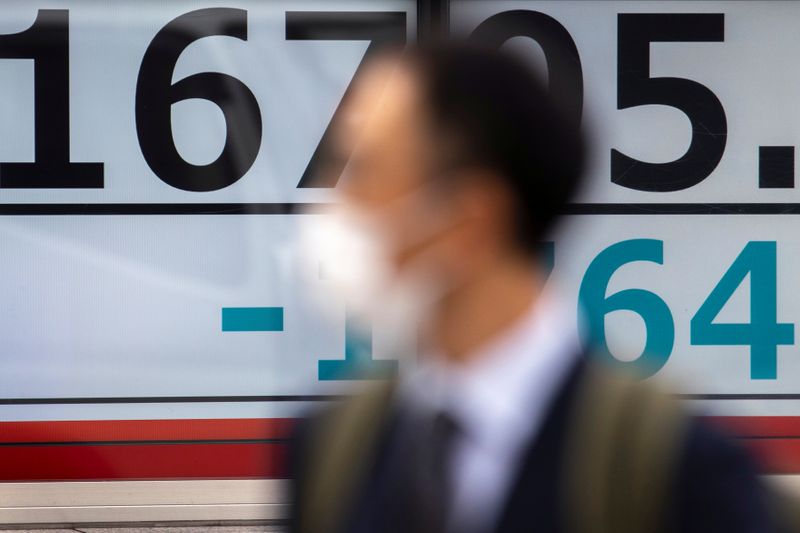
SYDNEY/NEW YORK (Reuters) - Asian shares were cautiously higher on Wednesday as investors paused ahead of the U.S. Federal Reserve's policy decision while oil prices jumped on hopes demand will pick up as many countries lift some of the coronavirus-related restrictions.
In early Asian trade, MSCI (NYSE:)'s broadest index of Asia-Pacific shares outside Japan () added 0.2% for its third straight day of gains.
Japan's markets were closed for a public holiday.
Australia () climbed 0.2% and South Korea () rose 0.3%. New Zealand shares () slipped 0.6%.
"The market narrative remained centered around recent competing themes with stimulus and reopening flagged as large tailwinds...accompanied by concerns about behavioural changes in the household and corporate sectors weighing on growth," said Matthew Sherwood, head of investment strategy at Perpetual.
"We remain concerned to the extent that Fed liquidity can offset systemic risks in credit markets."
Markets were looking for any forward guidance from the U.S. Federal Reserve, which is due to issue a policy statement at the close of its two-day meeting on Wednesday. The European Central Bank meets on Thursday.
Analysts said it was unlikely the Fed would make further major policy moves, given the scope and depth of its efforts to counter the economic damage caused by the coronavirus.
On Wall Street overnight, investors dumped tech giants despite an earnings beat from Alphabet Inc's Google (O:), driving all three major U.S. stock indexes into the red.
The Dow Jones Industrial Average () fell 0.3%, the S&P 500 () lost 0.5% and the tech-heavy Nasdaq Composite () dropped 1.4%.
Investors are next eyeing earnings from the other major tech firms - Facebook (O:), Amazon (O:) and Apple (O:).
"There was a big sector rotation as money left high value, growth sectors in tech like Amazon and went to value and cyclical sectors like energy, industrial, financials," said Tim Ghriskey, chief investment strategist at Inverness Counsel in New York.
Reassuring UBS earnings lifted European banks nearly 5%, while Wall Street digested upbeat numbers from industrial conglomerate 3M Co (N:), a maker of N95 respirator masks, and drugmaker Pfizer Inc (N:).
In currencies, the dollar weakened against the Japanese yen to 106.60 on concerns the coronavirus could spread further than previously thought if businesses reopened prematurely.
The euro () was up 0.2% at $1.0840 though the euro index () eased after Fitch cut Italy's credit rating to BBB-, just one notch above "junk" status.
The () against a basket of currencies fell 0.1%.
In commodities, U.S. crude () jumped 9% to $13.44 per barrel, and Brent () was up 1% at $20.65.
U.S. crude was trading above $50 a barrel just in February.
Gold was a shade weaker at $1,706.32 an ounce.
Disclaimer:Fusion Media would like to remind you that the data contained in this website is not necessarily real-time nor accurate. All CFDs (stocks, indexes, futures) and Forex prices are not provided by exchanges but rather by market makers, and so prices may not be accurate and may differ from the actual market price, meaning prices are indicative and not appropriate for trading purposes. Therefore Fusion Media doesn`t bear any responsibility for any trading losses you might incur as a result of using this data.
Fusion Media or anyone involved with Fusion Media will not accept any liability for loss or damage as a result of reliance on the information including data, quotes, charts and buy/sell signals contained within this website. Please be fully informed regarding the risks and costs associated with trading the financial markets, it is one of the riskiest investment forms possible.
The S&P/TSX Composite Index extended its rally Tuesday, rising 1.07 per cent while benchmark indices south of the border erased gains to close in the red. The broad market S&P 500 closed 0.52 per cent lower, the Dow Jones Industrial Average fell a modest 0.13 per cent and the tech-heavy Nasdaq Composite Index was the laggard with a 1.40 per cent drop.
It’s shaping up to be a busy week for the Nasdaq, with a slew of tech titans reporting earnings as investors digest the early fallout of the COVID-19 pandemic and economic lockdown.
In Toronto, eight of the eleven TSX subgroups closed in positive territory, led by energy, consumer discretionary and financials. Health care, consumer staples and information technology bucked the trend to end Tuesday’s trading session lower.
In all, 150 of the TSX’s 230 constituents finished in the green.
Lumber stocks were noticeable outperformers, with Canfor Corp., West Fraser Timber Ltd. and Norbord Inc. all notching double-digit gains to rank among the top-performing stocks on the TSX.
Global oil prices remained mixed, with the price for U.S. benchmark West Texas Intermediate for June delivery falling 0.8 per cent to US$12.70 per barrel, while the world benchmark Brent crude held on to a three per cent gain.
WTI has been roiled by a number of technical changes to the methodology of major oil funds, which hold large volumes of the futures contracts for American oil. Those funds have been rebalancing their holdings toward contracts for later delivery in an effort to avoid having their net asset value fall below zero, after contracts for May delivery plunged into negative territory shortly before their expiration last week.
While some of the movement in near-dated crude contracts is a result of technical trading mechanisms interfering with the organic supply and demand dynamics of crude pricing, concerns remain about global oversupply in the face of demand destruction resulting from the virus outbreak.
The Canadian dollar held near 71.46 cents U.S., up two-tenths of a cent against its American counterpart, though the greenback was broadly weaker against all of its major-market peers.
2:00 p.m. ET: North American equity markets retrace lost ground into mid-afternoon
North American equity markets bounced off the lows into the waning hours of Tuesday’s trade, with the S&P/TSX Composite Index rising 1.2 per cent, the S&P 500 and Dow Jones Industrial Average up a little more than a quarter of a per cent and the Nasdaq Composite Index shedding about half a per cent.
In Toronto, eight of the 11 TSX subgroups were higher, led by energy, consumer discretionary and financials. Health care, information technology and consumer staples remained in negative territory.
154 of the composite’s 230 constituents were in the green, led by Canfor Corp., Teck Resources Ltd. and NFI Group Inc.
Oil prices remained mixed, with U.S. benchmark West Texas Intermediate down about 2.5 per cent to trade at US$12.50 per barrel while the global Brent crude price was up about two per cent. Alberta’s Western Canadian Select was trading lower, down 29 per cent to trade at US$4.62 per barrel.
The Canadian dollar moderated gains, up two-tenths of a cent against its U.S. counterpart to trade at 71.45 cents U.S.
11:00 a.m. ET: North American markets give back early gains into late morning
North American equity markets traded near session lows into the late morning, with the S&P/TSX Composite clinging to a modest 0.3 per cent gain, and benchmark stock indices south of the border sliding into the red. The S&P 500 and Dow Jones Industrial Average both traded modestly lower, while the tech-heavy Nasdaq Composite Index fell about one per cent.
It’s a busy week for Nasdaq-listed stocks, with a slew of earnings from tech titans including Google parent company Alphabet Inc., Facebook Inc., Apple Inc., Amazon.com Inc. and Microsoft Corp. all reporting earnings in the coming days.
In Toronto, seven of the 11 TSX subgroups were trading in positive territory, with energy, consumer discretionary and financials notching the largest percentage gains. Health care, information technology and materials posted the largest losses.
U.S. benchmark oil prices moderated some losses, with WTI trading about four per cent lower at about US$12.25 per barrel.
9:40 a.m. ET: North American equity markets extend rally in risk-on trade
North American equity markets rallied into the opening trade Tuesday, extending Monday’s gains as a risk-on trade saw investors buy into assets like equities. The S&P/TSX Composite Index – now up more than 30 per cent from the March 23 trough – rose about one per cent out of the gate, the S&P 500 and Dow Jones Industrial Average gained about one-and-a-half per cent and the Nasdaq Composite Index was up one per cent.
Toronto’s benchmark index has now recouped about half of its losses from the February 20 peak to that March trough.
Global oil prices were mixed, with international benchmark Brent up nearly five per cent while American West Texas Intermediate for June delivery was essentially unchanged at US$12.75 per barrel. WTI has been notably volatile due to changes in the methodology of some major oil funds, as they shift their holdings away from futures for first-month delivery into longer-dated contracts.
The moves have been made in an effort to prevent the funds from having negative net asset values after last week’s historic plunge in the expiring May contract, which traded at negative US$40 per barrel ahead of expiration.
Alberta’s Western Canadian Select fell nearly 16 per cent to trade at US$5.48 per barrel, though Canadian crude is only priced a handful of times per day.
The Canadian dollar gained four-tenths of a cent against its U.S. counterpart to trade at 71.68 cents U.S. However, the greenback was showing noticeable weakness against all its global peers as investors took a more risk-on tone and sold traditional safe-haven assets.