Kamis, 03 Maret 2022

GTA home prices up 28% from last year as supply remains hampered: TRREB - CP24 Toronto's Breaking News


Tara Deschamps, The Canadian Press
Published Thursday, March 3, 2022 5:24AM EST
Last Updated Thursday, March 3, 2022 5:24AM EST

There was no relief for Greater Toronto Area homebuyers last month as the average home price crept up nearly 28 per cent when compared with last year as a lack of supply continued to hamper the market.

The Toronto Regional Real Estate board revealed Thursday that the average selling price for a home in the region surpassed $1.3 million last month, up from just above $1 million last February and more than $1.2 million in January of this year.

The average price of a detached home hit more than $1.7 million last month, with semi-detached properties at $1.3 million, townhouses at $1.1 million and condos nearing $800,000.

The Ontario board laid much of the blame for the soaring prices on demand greatly outpacing supply and thus, fuelling a market where bidding wars, few sellers and a frenzied atmosphere have been the norm.

However, the board said it detected signs in February that the region is making a "modest move" toward a "slightly more balanced" market.

Those traces of an easing came in the form of new listings, which are still down from a year ago, but by a marginally lesser annual rate than sales.

New listings for the month totalled 14,147, an almost seven per cent drop from 15,146 last February.

Meanwhile, 9,097 homes changed hands last month compared with 10,929 last February and 5,622 in January of this year.

That means February home sales were down compared with the all-time record set in 2021, but still eked out the second highest sales rate for the month.

TRREB had forecast sales would be lower this year because many people rushed to purchase homes last year or in the early weeks of 2022 in a bid to get ahead of looming interest rate hikes.

On Wednesday, the Bank of Canada hiked its benchmark interest rate to 0.5 per cent from 0.25, where it has sat for the last two years of the COVID-19 pandemic and served as an incentive to cash-strapped buyers.

The rise will increase the cost of loans, including variable-rate mortgages.

TRREB believes the rate hike will have a "moderating effect" on home sales, but will be countered by substantial immigration levels and a continued lack of supply.

It does not see home prices abating in the near-term.

"Because inventory remains exceptionally low, it will take some time for the pace of price growth to slow," said Jason Mercer, the board's chief market analyst, in a press release.

"Look for a more moderate pace of price growth in the second half of 2022 as higher borrowing costs result in some households putting their home purchase on hold temporarily as they resituate themselves in the market."

This report by The Canadian Press was first published March 3, 2022.

Adblock test (Why?)


https://news.google.com/__i/rss/rd/articles/CBMiaWh0dHBzOi8vd3d3LmNwMjQuY29tL25ld3MvZ3RhLWhvbWUtcHJpY2VzLXVwLTI4LWZyb20tbGFzdC15ZWFyLWFzLXN1cHBseS1yZW1haW5zLWhhbXBlcmVkLXRycmViLTEuNTgwMzY4NtIBAA?oc=5

2022-03-03 10:24:14Z
1316887483

Rabu, 02 Maret 2022

Fitbit recalls Ionic smartwatch after 78 reports of burns - The Verge

Fitbit announced today that it’s working with the Consumer Product Safety Commission to voluntarily recall its Ionic smartwatch. The company says it’s received over 100 reports of the watch’s lithium-ion battery overheating, as well as 78 reports of burn injuries to customers.

“Customer safety is always Fitbit’s top priority and out of an abundance of caution, we are conducting a voluntary recall of Fitbit Ionic smartwatches,” Fitbit said in a statement. It went on to say that the reported cases represent less than 0.01 percent of units sold. Roughly 1 million Ionic smartwatches were sold in the US, with an additional 693,000 sold internationally.

If you have an Ionic smartwatch, Fitbit recommends you stop using it immediately. The company says it’ll provide prepaid packaging for returns and will issue a refund of $299. It says it’ll also extend a 40 percent discount code for select Fitbit devices. You can call at 888-925-1764 or visit Fitbit’s online refund center here.

According to the CPSC, Fitbit received 115 reports in the US and 59 reports internationally of the Ionic’s battery overheating. More troubling, the company received 78 reports of burn injuries in the US and an additional 40 reports internationally. Of the reported burn injuries, Fitbit received two reports of third-degree burns and four reports of second-degree burns.

Launched in 2017, the Ionic was Fitbit’s first real attempt at a smartwatch after acquiring Pebble. It was one of the first wearables to introduce SpO2 sensors, but the watch disappointed in terms of sales due to its lackluster design and limited smart capabilities. Ironically, reviewers praised the Ionic’s weeklong battery life as one of its best features. Fitbit discontinued the Ionic in 2020.

Adblock test (Why?)


https://news.google.com/__i/rss/rd/articles/CBMiZmh0dHBzOi8vd3d3LnRoZXZlcmdlLmNvbS8yMDIyLzMvMi8yMjk1Nzk4OS9maXRiaXQtaW9uaWMtcmVjYWxsLWJ1cm5zLXNtYXJ0d2F0Y2gtZml0bmVzcy10cmFja2VyLXJlZnVuZNIBAA?oc=5

2022-03-02 13:51:14Z
1321961339

Bank of Canada hikes key interest rate - CP24 Toronto's Breaking News

The Bank of Canada raised its key interest rate target for the first time since slashing its benchmark rate to its rock-bottom level at the start of the COVID-19 pandemic.

The central bank increased its key rate by a quarter of a percentage point to 0.5 per cent on Wednesday in a bid to help fight inflation which is at its highest level since 1991.

The higher rate is expected to prompt the country's big banks to raise their prime lending rates, a move that will increase the cost of loans such as variable-rate mortgages that are linked to the benchmark.

The Bank of Canada cut its key interest rate to the emergency level of 0.25 per cent in March 2020 in an effort to help the economy weather the economic shock of the pandemic.

Since then, the economy has rebounded and inflation has jumped with the central bank saying today that it now expects inflation to be higher in the near-term than it previously thought.

The annual inflation rate in January of 5.1 per cent marked a three-decade high.

The Bank of Canada previously forecast annual inflation for the first quarter would be 5.1 per cent, but that was before Russia’s invasion of Ukraine sent oil prices higher and created new supply disruptions that will add to global price pressures.

The bank said persistently elevated inflation raises the risk that Canadians start to expect that inflation will stay higher for longer.

To keep inflation and expectations anchored, the bank said it plans to use interest rates to get inflation rates back to its two per cent target.

Senior decision-makers at the bank expect interest rates will need to rise further, although the timing and pace of those hikes will be tied to how the bank views the Canadian economy.

Statistics Canada said Tuesday that the economy grew at an annual rate of 6.7 per cent over the last three months of 2021, which was stronger than the Bank of Canada had expected.

The bank also expects growth in the first quarter to be more solid than its previous projections in January, even with an Omicron-related setback that month that saw 200,000 jobs lost.

The bank said the labour market setback should be temporary, and strong household spending should strengthen further as public health restrictions ease as several provinces have started to do this month.

Still, the bank said COVID-19 and the possibility of new variants remain a concern.

This report by The Canadian Press was first published March 2, 2022.

Adblock test (Why?)


https://news.google.com/__i/rss/rd/articles/CBMiUWh0dHBzOi8vd3d3LmNwMjQuY29tL21vYmlsZS9uZXdzL2Jhbmstb2YtY2FuYWRhLWhpa2VzLWtleS1pbnRlcmVzdC1yYXRlLTEuNTgwMjAwN9IBAA?oc=5

2022-03-02 15:37:15Z
1319660644

Bank of Canada readies interest rate announcement - CP24 Toronto's Breaking News


The Canadian Press
Published Wednesday, March 2, 2022 5:17AM EST
Last Updated Wednesday, March 2, 2022 5:17AM EST

OTTAWA-- The Bank of Canada is poised this morning to raise its trendsetting interest rate after signalling the move a few weeks ago when it said it would no longer promise to keep the rate at emergency levels.

It was two years this week that the Bank of Canada first cut its key policy rate in response to get ahead of any economic fallout from a novel coronavirus.

What followed were two more rate cuts in March 2020 that brought the key policy rate to 0.25 per cent, where it has stayed since then.

The central bank recently pointed to better-than-expected economic growth to end to 2021, a roaring housing market and inflation rates at three-decade highs as signs it may be time to hike rates from emergency levels.

BMO chief economist Douglas Porter says he expects the central bank to raise its rate by a quarter percentage point to 0.5 per cent.

He says the first rate hike may have the largest affect on how households manage their debt, but the central bank would have to raise rates by a full percentage point before there is an effect on the country's housing market.

"Every single basis point matters to somebody out there," Porter says.

"We'd need to see a number of Bank of Canada interest rate hikes before it would really begin to seriously affect the economy."

A rate hike generally takes as little as six months or as many as 18 months before it has an effect on headline inflation.

The annual inflation rate rose to 5.1 per cent in January and are expected to go higher with rising global oil prices.

This report by The Canadian Press was first published March 2, 2022.

Adblock test (Why?)


https://news.google.com/__i/rss/rd/articles/CBMiVWh0dHBzOi8vd3d3LmNwMjQuY29tL25ld3MvYmFuay1vZi1jYW5hZGEtcmVhZGllcy1pbnRlcmVzdC1yYXRlLWFubm91bmNlbWVudC0xLjU4MDIwMDfSAQA?oc=5

2022-03-02 10:17:29Z
1319660644

Selasa, 01 Maret 2022

Is Russia 'panic gold buying'? And is panic-selling about to kick in? - Kitco NEWS

(Kitco News) The Bank of Russia said it would be restarting its official gold purchases after a two-year hiatus. But some analysts warn that gold-selling is not that far off as Russia battles sanctions and a plummeting ruble.

On Sunday, Russia’s central bank announced that it would resume its gold purchases from the domestic market as it attempts to establish some financial stability amid a barrage of new sanctions following Moscow’s full-scale invasion of Ukraine.

Russia’s economy is starting to feel very isolated after the West implemented sanctions that penalized Russia’s central bank and excluded several Russian banks from the SWIFT payment system.

In the meantime, gold has rallied in response to Russia’s invasion of Ukraine, with investors fleeing to the safe-haven metal for protection. In February, prices rose $120, with April Comex gold futures last trading at $1,926.40 an ounce.


On top of the geopolitical uncertainty, more central bank gold buying is usually a good price driver. However, some analysts warn that Russia’s additional gold purchases could be just a precursor to significant selling.

Russia could be resuming purchases of its domestic gold to boost its own war chest, which is a short-term bullish driver for the metal, but it is likely only a matter of time before Russia starts selling its gold reserves, said MKS PAMP SA head of metals strategy Nicky Shiels.

“[Russia] will continue to usurp [its] own production of Gold (and Palladium – ‘precious metals’), to bolster the war chest. That’s likely to be viewed as initially bullish by the market (‘panic gold buying’), but the purpose of buying gold (in the domestic market), is to monetize it when required,” Shiels said in a note. “One builds a war chest of this size ($140bn, 74mn oz of Gold) for times like these.”

And the fear of Russia selling its gold reserves in large quantities will weigh heavily on the market going forward, especially if the ruble continues to plunge, Shiels pointed out.

“It’s the impact to sentiment … the fear over potential CB sales may overhang the market after the dust settles/further escalation premium is priced in,” she said. “The RUB is also likely to collapse further, which will also make it even more appetizing to sell metal priced in local currency terms to whoever needs/wants it.”

Russia’s decision to resume gold purchases comes almost two years after its central bank suspended its domestic gold-buying program. This was at a time when gold prices soared at the onset of the pandemic.

Prior to that, Russia spent years boosting its gold reserves. Last year, the value of Russian gold in its forex reserves had surpassed the country’s U.S. dollar holdings for the first time ever. At the end of June 2020, the country’s total gold reserves as part of the foreign exchange holdings were up at 22.9%.

This represents Russian President Vladimir Putin’s border strategy to de-dollarize the Russian economy and protect it from further sanctions.

According to the latest IMF data, Russia holds nearly 2,300 tonnes of gold as of the end of January — the fifth-biggest sovereign gold owner.

Adblock test (Why?)


https://news.google.com/__i/rss/rd/articles/CBMibGh0dHBzOi8vd3d3LmtpdGNvLmNvbS9uZXdzLzIwMjItMDMtMDEvSXMtUnVzc2lhLXBhbmljLWdvbGQtYnV5aW5nLUFuZC1pcy1wYW5pYy1zZWxsaW5nLWFib3V0LXRvLWtpY2staW4uaHRtbNIBAA?oc=5

2022-03-01 17:10:00Z
1313230228

Oil Prices Soar Despite News Of Strategic Petroleum Reserve Release - OilPrice.com

Oil Prices Soar Despite News Of Strategic Petroleum Reserve Release | OilPrice.com
Julianne Geiger

Julianne Geiger

Julianne Geiger is a veteran editor, writer and researcher for Oilprice.com, and a member of the Creative Professionals Networking Group.

More Info

Premium Content

  • IEA Ministerial Meeting concluded with an agreement to release 60 million barrels from various countries' SPR reserves.
  • Analysts have questioned how much of an impact it would really have on the global markets.
  • Crude prices continued to rally on Tuesday morning despite the news of concerted SPR releases.

The IEA Ministerial Meeting being held on Tuesday has resulted in an agreement of some of its members to release 60 million barrels of crude oil from various countries’ strategic petroleum reserves.

The United States has agreed to release 30 million barrels of crude oil from its SPR. The rest of the IEA members in Europe and Asia will release the remaining 30 million barrels.

The concerted release is said to have a greater impact on the global oil markets than just a single country’s release—but analysts have questioned how much of an impact it would really have on the global markets, considering that 60 million barrels is less than a day of global oil demand.

But what the market is fearing here is lost Russian barrels. Lost to the market, that is. And for this, we’re talking about less than 7 million barrels a day that are exported.

To offset that with 60 million barrels for a short while is certainly achievable. What’s more, it’s very unlikely that all Russian crude oil exports would be stopped, even if they are sanctioned. It is far more likely that China would continue to purchase crude oil from Russia even if there are sanctions, leaving an even smaller share for the SPR releases to cover.

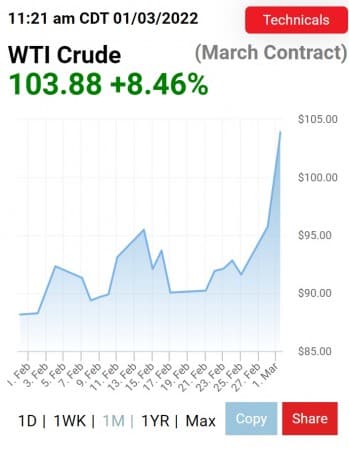
But the market is interpreting the 60 million barrels as a mere drop in the big oil bucket, as evidenced by the rise in prices. Shortly after the announcement, WTI shot up $8.54 (+8.92%) on the day to $104.26. Brent, meanwhile, jumped up $7.85 (+8.01%) to $105.82 per barrel on the day.

The SPR release seems to have the opposite of the intended effect on oil prices, and that’s not terribly surprising. An announced SPR release is also a signal to the market that the market is in trouble. Global crude oil inventories are low, and demand is soaring. And now, Russia’s oil supply—or at least part of it—could soon be unavailable to the Western world should additional sanctions become necessary. The announcement of the release of barrels from the SPR only highlights those issues.

The IEA, however, has said that the SPR release sends “a unified and strong message to global oil markets that there will be no shortfall in supplies as a result of Russia’s invasion of Ukraine.”

By Julianne Geiger for Oilprice.com

More Top Reads From Oilprice.com:


Download The Free Oilprice App Today

Back to homepage


Related posts

Adblock test (Why?)


https://news.google.com/__i/rss/rd/articles/CBMic2h0dHBzOi8vb2lscHJpY2UuY29tL0VuZXJneS9FbmVyZ3ktR2VuZXJhbC9PaWwtUHJpY2VzLVNvYXItRGVzcGl0ZS1OZXdzLU9mLVN0cmF0ZWdpYy1QZXRyb2xldW0tUmVzZXJ2ZS1SZWxlYXNlLmh0bWzSAQA?oc=5

2022-03-01 16:20:00Z
1312686517

The Russian central bank's gold holdings and the struggling ruble - Kitco NEWS

Editor's Note: With so much market volatility, stay on top of daily news! Get caught up in minutes with our speedy summary of today's must-read news and expert opinions. Sign up here!

(Kitco News) - Statista Data Journalist Katharina Buchholz has recently put together some data on where the Russian central bank's gold is being held. It seems like a very prominent subject at the moment as governments around the world are putting sanctions on the nation. China was the single-biggest foreign holder of Russian central bank reserves as of June 30, 2021, holding 13.8 percent of the total of Russia’s reserves. It has been said that this is a mix of gold and foreign currency and roughly the same share of assets held in Chinese currency Yuan Renminbi.

The report said the biggest share of reserves is that held in Russia itself. The main component of this is in the form of gold, making up 21.7 percent of the total. With the sanctions against its central bank progressing, this means Russia would likely remain in charge of around one-third of its current $630 billion strong reserves through domestic gold and Chinese Yuan.

Recently EU countries, along with the U.K., U.S., and Canada moved to freeze Russia's assets. According to Statista, around 25 percent of Russia’s reserve assets were held in France, Germany, and Austria. The total reserves held in Eurozone stood at around 32 percent a significant figure.

Back to gold and the total of its total holdings is surprising a decent amount of the yellow metal. Around 21.7% of the total central bank reserves are gold. As the Russian Ruble is plummeting it seems a very prudent thing that the central bank is holding that amount of the precious metal. Longer-term as there is a flight of capital from Russia gold could start to look even more attractive. On Monday, it was reported that Russia's central bank said it would resume buying gold on the domestic market from this week. It is taking these measures to try and ensure financial stability during Western sanctions against Moscow for its invasion of Ukraine.

Adblock test (Why?)


https://news.google.com/__i/rss/rd/articles/CBMibGh0dHBzOi8vd3d3LmtpdGNvLmNvbS9uZXdzLzIwMjItMDMtMDEvVGhlLVJ1c3NpYW4tY2VudHJhbC1iYW5rLXMtZ29sZC1ob2xkaW5ncy1hbmQtdGhlLXN0cnVnZ2xpbmctcnVibGUuaHRtbNIBAA?oc=5

2022-03-01 11:44:00Z
1313230228