Senin, 05 Juli 2021

China Widens Probe Beyond Didi, Roiling Global Investors - Yahoo Finance

(Bloomberg) -- China expanded its latest crackdown on the technology industry beyond Didi Global Inc. to include two other companies that recently listed in New York, dealing a blow to global investors while tightening the government’s grip on sensitive online data.

In a series of announcements that began on Friday and escalated over a holiday weekend in the U.S., Beijing ordered all three companies to halt new user registrations and told app stores to remove Didi’s service from their platforms. The regulatory onslaught came just days after the ride-hailing giant completed one of the biggest U.S. listings of the past decade and within weeks of debuts by the other targeted companies -- Full Truck Alliance Co. and Kanzhun Ltd.

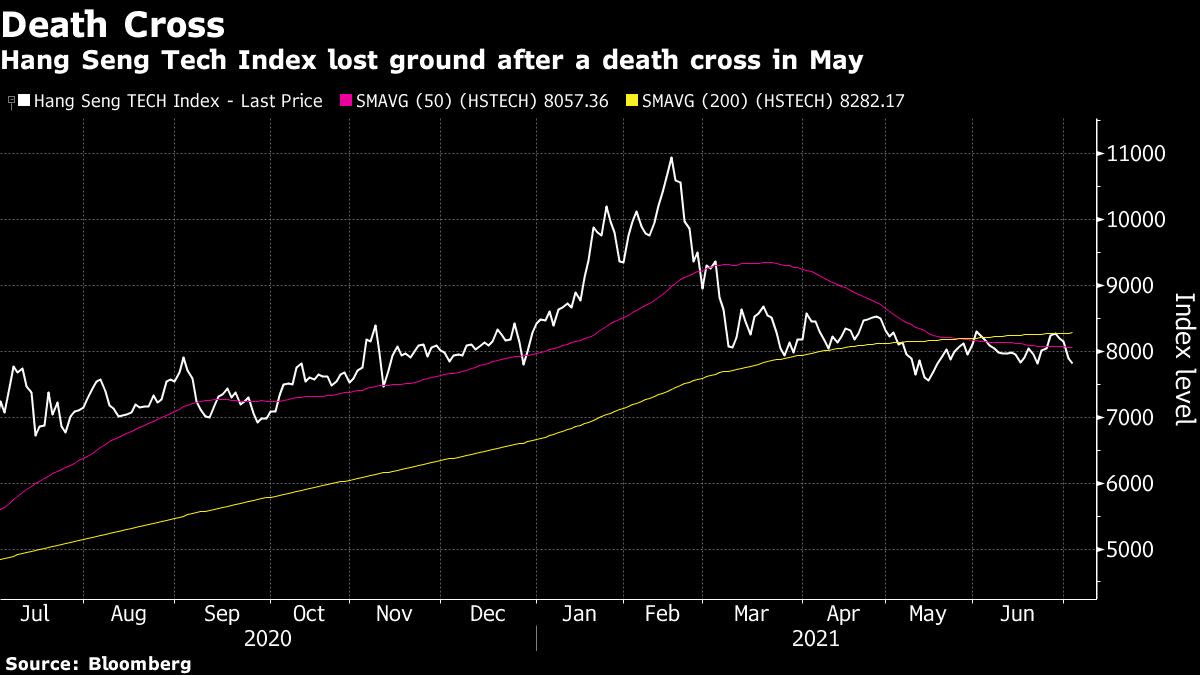
Investors responded by dumping Chinese tech stocks in Hong Kong and sending shares of SoftBank Group Corp., a backer of both Didi and Full Truck, to a seven-month low in Tokyo. Didi, which tumbled 5.3% on Friday, could extend losses when trading resumes in the U.S. on Tuesday.

While China watchers have been on high alert for regulatory shocks since Beijing scuttled Jack Ma’s IPO of Ant Group Co. in November, the move against Didi and its peers adds a new dimension -- cybersecurity -- to a clampdown that has so far focused on fintech and antitrust issues. The Communist Party-backed Global Times said in a Monday column that Didi’s data hoard posed a threat to individual privacy as well as national security, particularly since its top two shareholders -- SoftBank and Uber Technologies Inc. -- were foreign.

Beijing’s targeting of recent U.S. listings may chill the pipeline of overseas IPOs that have enriched Wall Street and private Chinese firms alike. That could in turn fuel concerns of an economic decoupling between China and the U.S., at least in sensitive areas like technology, as both Xi Jinping and Joe Biden take steps to limit the flow of capital and expertise between the two superpowers. Helping tech companies sell shares in New York has been a lucrative business for firms like Goldman Sachs Group Inc. and Morgan Stanley, both of which were key underwriters of the Didi IPO.

Among the questions still lingering for global investors, Chinese tech bosses and U.S. regulators: Which companies might enter Beijing’s crosshairs next? And in Didi’s case, should investors have been given more explicit warnings about China’s clampdown before the IPO?

“Didi seems to have rushed up their IPO process, indicating that there might be early signs of upcoming government scrutiny,” said Shen Meng, director of Beijing-based boutique investment bank Chanson & Co. “The Didi probe, together with the other investigations announced today, show how the tensions between China and the U.S. are spilling over into the capital markets. The incident will suppress Chinese companies’ desire to go public in the U.S.”

Didi undoubtedly has the most detailed travel information on individuals among large internet firms and appears to have the ability to conduct “big data analysis” of individual behaviors and habits, the Global Times wrote Monday. To protect personal data as well as national security, China must be even stricter in its oversight of Didi’s data security, given that it’s listed in the U.S. and its two largest shareholders are foreign companies, the newspaper added.

“We must never let any internet giant control a super database that has more detailed personal information than the state, let alone giving it the right to use the data at will,” the Global Times said in the commentary. While it’s not clear how Didi illegally collected personal data, companies should gather the least amount of information required for their services, it added.

The probe is part of a wider crackdown on China’s largest internet corporations, as the government seeks to tighten the ownership and handling of the troves of information they gather daily from hundreds of millions of users. As part of the reviews, the Cyberspace Administration of China ordered Didi, Full Truck Alliance’s Huochebang and Yunmanman platforms, as well as Kanzhun’s Boss Zhipin to halt new registrations, though existing customers can continue to use their services.

For more on China’s latest crackdown

What Is Didi and Why Is China Cracking Down on It?: QuickTakeChina Widens Security Probe to Two More U.S.-Listed FirmsBeijing’s Blocking of Didi App Sends Peers Tumbling in Hong KongChina Blocks Didi From App Stores Days After Mega U.S. IPOXi’s Next Target in Tech Crackdown Is China’s Vast Reams of DataWhat Is Behind China’s Crackdown on Its Tech Giants: QuickTake

On Sunday, Didi said on social media that it had already halted new user registrations as of July 3 and was now working to rectify its app in accordance with regulatory requirements. It offered its sincere thanks to authorities for their oversight. In a follow-up statement, Didi said the regulatory move may have “an adverse impact” on its revenue in China.

The investigation comes hot on the heels of Didi’s float, which listed on Wednesday in New York after a $4.4 billion IPO -- the largest by a Chinese firm in the U.S. after Alibaba. SoftBank owned roughly 20% of Didi following the listing, while Uber’s stake was about 12%, according to an earlier Didi filing. Founder Cheng Wei owned about 6.5%, just ahead of the 6.4% held by Tencent. SoftBank sank 5.4% in Tokyo trading Monday to the lowest since Dec. 8.

Even before the CAC’s crackdown, Didi had been under close scrutiny from regulators since a pair of murders in 2018 that founder Cheng has called the firm’s “darkest days.” It was among 34 firms told by the antitrust watchdog to conduct self-inspections and rectify abuses, while the transport ministry had ordered ride-hailing companies including Didi to review their practices relating to driver income and pricing.

Full Truck Alliance, backed by Tencent, is little changed since it raised $1.6 billion in a June 21 listing. Kanzhun, also part of Tencent’s investment portfolio, has nearly doubled after its $912 million IPO. Other firms that listed in the U.S. last month as part of a boom in Chinese companies selling shares overseas include grocery services MissFresh Ltd. and DingDong Cayman Ltd.

Other tech stocks fell in Hong Kong trading Monday. Tencent retreated as much as 4.5%, touching its lowest level this year. Alibaba sank more than 3%, while Meituan and Kuaishou Technology, a short video streaming platform that listed in the Asian financial center earlier this year, tumbled more than 7%.

“It’s clear that there’s a regulatory overhang on China’s tech giants at the moment and that may continue to weigh on sector valuations for the large internet platforms,” according to Matthew Kanterman, an analyst at Bloomberg Intelligence.

(Updates with shares of other Chinese tech firms in 15th paragraph)

More stories like this are available on bloomberg.com

Subscribe now to stay ahead with the most trusted business news source.

©2021 Bloomberg L.P.

Adblock test (Why?)


https://news.google.com/__i/rss/rd/articles/CBMiUWh0dHBzOi8vZmluYW5jZS55YWhvby5jb20vbmV3cy9kaWRpLXByb2JlLW5lZWRlZC1uYXRpb25hbC1zZWN1cml0eS0wMTI1MTgzMDIuaHRtbNIBWWh0dHBzOi8vZmluYW5jZS55YWhvby5jb20vYW1waHRtbC9uZXdzL2RpZGktcHJvYmUtbmVlZGVkLW5hdGlvbmFsLXNlY3VyaXR5LTAxMjUxODMwMi5odG1s?oc=5

2021-07-05 07:15:45Z
52781708854966

Minggu, 04 Juli 2021

Nova Scotia reports 3 new COVID-19 cases Sunday - HalifaxToday.ca

NEWS RELEASE
COVID-19/HEALTH/WELLNESS
*************************
Today, July 4, Nova Scotia is reporting three new cases of COVID-19 and two recoveries.

Two cases are in Central Zone and are close contacts of previously reported cases. 

The other case is in Eastern Zone and is a close contact of a previously reported case.

There is limited community spread in Central Zone. Eastern, Northern and Western Zones continue to be closely monitored for community spread.

"For the past week, we've seen daily new case numbers in the single digits which is a testament to the hard work of Nova Scotians. But we must keep up our hard work as restrictions ease and our borders open," said Premier Iain Rankin. "Getting tested regularly and getting vaccinated will help ensure we have a wonderful summer with friends and family." 

As of today, Nova Scotia has 53 active cases of COVID-19. Of those, two people are in hospital COVID-19 units.

On July 3, Nova Scotia Health Authority's labs completed 2,827 tests.

"Nova Scotians are working hard but we must continue to be vigilant by following public health measures," said Dr. Robert Strang, Nova Scotia's chief medical officer of health. "If you haven't had your first dose of the vaccine, please book it, and if you have, please book your second dose as soon as you're able."

Since April 1, there have been 4,111 positive COVID-19 cases and 26 deaths. Cases range in age from under 10 to over 90. There are 4,032 resolved cases. Cumulative cases may change as data is updated in Panorama.

Testing advice:

Nova Scotians with or without symptoms can book a test at https://covid-self-assessment.novascotia.ca/en for primary assessment centres across the province. Those with no symptoms are strongly encouraged to use pop-up sites if they want to be tested.

More information on testing can be found at https://www.nshealth.ca/coronavirustesting .

Anyone with COVID-19 symptoms is advised to self-isolate and book a COVID-19 test. Everyone they live with must also self-isolate until the person receives their first negative test result. If the test is positive, public health will advise everyone about what to do.

Anyone advised by public health that they were a close contact needs to complete a full 14-day quarantine, regardless of test results. If the close contact is symptomatic, everyone they live with must also self-isolate until the person receives their first negative test result. If the test is positive, public health will advise everyone about what to do.

Symptoms and self-assessment:

Nova Scotians should visit https://covid-self-assessment.novascotia.ca/ to do a self-assessment if in the past 48 hours they have had or are currently experiencing mild symptoms, including:

-- fever (i.e. chills/sweats) or cough (new or worsening)
-- sore throat
-- runny nose/nasal congestion
-- headache
-- shortness of breath/difficulty breathing

People should call 811 if they cannot access the online self-assessment or wish to speak with a nurse about their symptoms.

Anyone with symptoms should immediately self-isolate and book a test.

Quick Facts:
-- a state of emergency was declared under the Emergency Management Act on March 22, 2020, and extended to July 11, 2021

Additional Resources:
More information on COVID-19 case data, testing and vaccines is available at: https://novascotia.ca/coronavirus/data/

Nova Scotians can find accurate, up-to-date information, handwashing posters and fact sheets at: https://novascotia.ca/coronavirus

Nova's Scotia's five-phase reopening plan, announced May 28, 2021: https://novascotia.ca/reopening-plan/

Businesses and other organizations can find information to help them safely reopen and operate at: https://novascotia.ca/reopening-nova-scotia

More information about public health text notifications of positive COVID-19 cases and close contacts is available here: https://www.nshealth.ca/news/public-health-begins-contacting-positive-covid-19-cases-close-contacts-text-message

More information on what is considered essential travel is available here: https://novascotia.ca/coronavirus/travel/#from-outside-atlantic-canada

Government of Canada: https://canada.ca/coronavirus  or 1-833-784-4397 (toll-free)

The Mental Health Provincial Crisis Line is available 24/7 to anyone experiencing a mental health or addictions crisis, or someone concerned about them, by calling 1-888-429-8167 (toll-free)

Anyone needing help with a non-crisis mental health or addiction concern can call Community Mental Health and Addictions at 1-855-922-1122 (toll-free) weekdays 8:30 a.m. to 4:30 p.m.

Kids Help Phone is available 24/7 by calling 1-800-668-6868 (toll-free)

For help or information about domestic violence 24/7, call 1-855-225-0220 (toll-free)

*************************

Adblock test (Why?)


https://news.google.com/__i/rss/rd/articles/CBMic2h0dHBzOi8vd3d3LmhhbGlmYXh0b2RheS5jYS9jb3JvbmF2aXJ1cy1jb3ZpZC0xOS1sb2NhbC1uZXdzL25vdmEtc2NvdGlhLXJlcG9ydHMtMy1uZXctY292aWQtMTktY2FzZXMtc3VuZGF5LTM5MjkwNjHSAXdodHRwczovL3d3dy5oYWxpZmF4dG9kYXkuY2EvYW1wL2Nvcm9uYXZpcnVzLWNvdmlkLTE5LWxvY2FsLW5ld3Mvbm92YS1zY290aWEtcmVwb3J0cy0zLW5ldy1jb3ZpZC0xOS1jYXNlcy1zdW5kYXktMzkyOTA2MQ?oc=5

2021-07-04 16:01:50Z
52781711393021

Major ransomware attack aimed at tech provider leaves other companies scrambling - CBC.ca

Businesses around the world rushed Saturday to contain a ransomware attack that has paralyzed their computer networks, a situation complicated in the U.S. by offices lightly staffed at the start of the Fourth of July holiday weekend.

It's not yet known how many organizations have been hit by demands that they pay a ransom in order to get their systems working again. But some cybersecurity researchers predict the attack targeting customers of software supplier Kaseya could be one of the broadest ransomware attacks on record.

The cybersecurity firm ESET says there are victims in least 17 countries, including the United Kingdom, South Africa, Canada, Argentina, Mexico, Kenya and Germany.

It follows a scourge of headline-grabbing attacks over recent months that have been a source of diplomatic tension between U.S. President Joe Biden and Russian President Vladimir Putin over whether Russia has become a safe haven for cybercriminal gangs.

Biden said Saturday he didn't yet know for certain who was responsible, adding he has directed U.S. intelligence agencies to investigate who was behind the attack.

"If it is either with the knowledge of and or a consequence of Russia then I told Putin we will respond," Biden said. "We're not certain. The initial thinking was it was not the Russian government."

Cybersecurity experts say the REvil gang, a major Russian-speaking ransomware syndicate, appears to be behind the attack that targeted Kaseya, using its network-management package as a conduit to spread the ransomware through cloud-service providers.

"The number of victims here is already over a thousand and will likely reach into the tens of thousands," said cybersecurity expert Dmitri Alperovitch of the Silverado Policy Accelerator think tank. "No other ransomware campaign comes even close in terms of impact."

In Sweden, most of the grocery chain Coop's 800 stores were unable to open because their cash registers weren't working, according to SVT, the country's public broadcaster. The Swedish State Railways and a major local pharmacy chain were also affected.

Kaseya working on a patch

Kaseya CEO Fred Voccola said in a statement that the company believes it has identified the source of the vulnerability and will "release that patch as quickly as possible, to get our customers back up and running."

Voccola said fewer than 40 of Kaseya's customers were known to be affected, but experts said the ransomware could still be affecting hundreds more companies that rely on Kaseya's clients that provide broader IT services.

John Hammond of the security firm Huntress Labs said he was aware of a number of managed-services providers — companies that host IT infrastructure for multiple customers — being hit by the ransomware, which encrypts networks until the victims pay off attackers.

"It's reasonable to think this could potentially be impacting thousands of small businesses," said Hammond, basing his estimate on the service providers reaching out to his company for assistance and comments on Reddit showing how others are responding.

At least some victims appeared to be getting ransoms set at $45,000 US, considered a small demand but one that could quickly add up when sought from thousands of victims, said Brett Callow, a ransomware expert at the cybersecurity firm Emsisoft.

Attack possibly timed for the holiday

"It's reasonable to think that the timing was planned" by hackers for the holiday, said James Shank, of threat intelligence firm Team Cymru.

REvil, the group most experts have tied to the attack, was the same ransomware provider that the FBI linked to an attack on Brazil-based JBS, a major global meat processor forced to pay a $11 million US ransom, amid the U.S. Memorial Day holiday weekend in May.

The federal Cybersecurity and Infrastructure Security Agency in the U.S. said in a statement that it is closely monitoring the situation and working with the FBI to collect more information about its impact.

CISA urged anyone who might be affected to "follow Kaseya's guidance to shut down VSA servers immediately." Kaseya runs what's called a virtual system administrator, or VSA, that's used to remotely manage and monitor a customer's network.

The privately held Kaseya is based in Dublin, with a U.S. headquarters in Miami.

Adblock test (Why?)


https://news.google.com/__i/rss/rd/articles/CBMiRWh0dHBzOi8vd3d3LmNiYy5jYS9uZXdzL3dvcmxkL2N5YmVyYXR0YWNrLXJhbnNvbXdhcmUta2FzZXlhLTEuNjA4OTU3ONIBIGh0dHBzOi8vd3d3LmNiYy5jYS9hbXAvMS42MDg5NTc4?oc=5

2021-07-04 13:54:15Z
52781710391277

Kaseya ransomware attack could be record-setting as its scope widens - Global News

Businesses around the world rushed Saturday to contain a ransomware attack that has paralyzed their computer networks, a situation complicated in the U.S. by offices lightly staffed at the start of the Fourth of July holiday weekend.

It’s not yet known how many organizations have been hit by demands that they pay a ransom in order to get their systems working again. But some cybersecurity researchers predict the attack targeting customers of software supplier Kaseya could be one of the broadest ransomware attacks on record.

Read more: Ransomware attack suspected from REvil gang hits at least 200 U.S. companies

It follows a scourge of headline-grabbing attacks over recent months that have been a source of diplomatic tension between U.S. President Joe Biden and Russian President Vladimir Putin over whether Russia has become a safe haven for cybercriminal gangs.

Biden said Saturday he didn’t yet know for certain who was responsible but suggested that the U.S. would respond if Russia was found to have anything to do with it.

“If it is either with the knowledge of and or a consequence of Russia then I told Putin we will respond,” Biden said. “We’re not certain. The initial thinking was it was not the Russian government.”

Cybersecurity experts say the REvil gang, a major Russian-speaking ransomware syndicate, appears to be behind the attack that targeted the software company Kaseya, using its network-management package as a conduit to spread the ransomware through cloud-service providers.

Click to play video: 'Toronto’s Humber River Hospital under code grey after ransomware attack' Toronto’s Humber River Hospital under code grey after ransomware attack
Toronto’s Humber River Hospital under code grey after ransomware attack – Jun 19, 2021

“The number of victims here is already over a thousand and will likely reach into the tens of thousands,” said cybersecurity expert Dmitri Alperovitch of the Silverado Policy Accelerator think tank. “No other ransomware campaign comes even close in terms of impact.”

The cybersecurity firm ESET says there are victims in at least 17 countries, including the United Kingdom, South Africa, Canada, Argentina, Mexico, Kenya and Germany.

In Sweden, most of the grocery chain Coop’s 800 stores were unable to open because their cash registers weren’t working, according to SVT, the country’s public broadcaster. The Swedish State Railways and a major local pharmacy chain were also affected.

Kaseya CEO Fred Voccola said in a statement that the company believes it has identified the source of the vulnerability and will “release that patch as quickly as possible to get our customers back up and running.”

Read more: Recent increases in ransomware attacks may lead to a new internet

Voccola said fewer than 40 of Kaseya’s customers were known to be affected, but experts said the ransomware could still be affecting hundreds more companies that rely on Kaseya’s clients that provide broader IT services.

John Hammond of the security firm Huntress Labs said he was aware of a number of managed-services providers — companies that host IT infrastructure for multiple customers — being hit by the ransomware, which encrypts networks until the victims pay off attackers.

“It’s reasonable to think this could potentially be impacting thousands of small businesses,” said Hammond, basing his estimate on the service providers reaching out to his company for assistance and comments on Reddit showing how others are responding.

At least some victims appeared to be getting ransoms set at $45,000, considered a small demand but one that could quickly add up when sought from thousands of victims, said Brett Callow, a ransomware expert at the cybersecurity firm Emsisoft.

Click to play video: 'U.S. recovers ‘majority’ of cryptocurrency paid in Colonial Pipeline ransomware attack' U.S. recovers ‘majority’ of cryptocurrency paid in Colonial Pipeline ransomware attack
U.S. recovers ‘majority’ of cryptocurrency paid in Colonial Pipeline ransomware attack – Jun 7, 2021

Callow said it’s not uncommon for sophisticated ransomware gangs to perform an audit after stealing a victim’s financial records to see what they can really pay, but that won’t be possible when there are so many victims to negotiate with.

“They just pitched the demand amount at a level most companies will be willing to pay,” he said.

Voccola said the problem is only affecting its “on-premise” customers, which means organizations running their own data centers. It’s not affecting its cloud-based services running software for customers, though Kaseya also shut down those servers as a precaution, he said.

The company added in a statement Saturday that “customers who experienced ransomware and receive a communication from the attackers should not click on any links — they may be weaponized.”

Read more: Ransomware attack on world’s largest meat producer disrupts global production

Gartner analyst Katell Thielemann said it’s clear that Kaseya quickly sprang to action, but it’s less clear whether their affected clients had the same level of preparedness.

“They reacted with an abundance of caution,” she said. “But the reality of this event is it was architected for maximum impact, combining a supply chain attack with a ransomware attack.”

Supply chain attacks are those that typically infiltrate widely used software and spread malware as it updates automatically.

Complicating the response is that it happened at the start of a major holiday weekend in the U.S., when most corporate IT teams aren’t fully staffed.

Click to play video: 'How hackers can exploit vulnerabilities in Canadian companies' How hackers can exploit vulnerabilities in Canadian companies
How hackers can exploit vulnerabilities in Canadian companies – May 10, 2021

That could also leave those organizations unable to address other security vulnerabilities, such a dangerous Microsoft bug affecting software for print jobs, said James Shank, of threat intelligence firm Team Cymru.

“Customers of Kaseya are in the worst possible situation,” he said. “They’re racing against time to get the updates out on other critical bugs.”

Shank said “it’s reasonable to think that the timing was planned” by hackers for the holiday.

The U.S. Chamber of Commerce said it was affecting hundreds of businesses and was “another reminder that the U.S. government must take the fight to these foreign cybercriminal syndicates” by investigating, disrupting and prosecuting them.

Read more: Ransomware demands double amid COVID-19, with health care industry a key target: report

The federal Cybersecurity and Infrastructure Security Agency said in a statement that it is closely monitoring the situation and working with the FBI to collect more information about its impact.

CISA urged anyone who might be affected to “follow Kaseya’s guidance to shut down VSA servers immediately.” Kaseya runs what’s called a virtual system administrator, or VSA, that’s used to remotely manage and monitor a customer’s network.

The privately held Kaseya is based in Dublin, Ireland, with a U.S. headquarters in Miami.

REvil, the group most experts have tied to the attack, was the same ransomware provider that the FBI linked to an attack on JBS SA, a major global meat processor forced to pay an $11 million ransom, amid the Memorial Day holiday weekend in May.

Click to play video: 'FBI: Russian hacker group to blame for ransomware attack on Colonial Pipeline' FBI: Russian hacker group to blame for ransomware attack on Colonial Pipeline
FBI: Russian hacker group to blame for ransomware attack on Colonial Pipeline – May 10, 2021

Active since April 2019, the group provides ransomware-as-a-service, meaning it develops the network paralyzing software and leases it to so-called affiliates who infect targets and earn the lion’s share of ransoms.

U.S. officials have said the most potent ransomware gangs are based in Russia and allied states and operate with Kremlin tolerance and sometimes collude with Russian security services.

Alperovitch said he believes the latest attack is financially motivated and not Kremlin-directed.

However, he said it shows that Putin “has not yet moved” on shutting down cybercriminals within Russia after Biden pressed him to do so at their June summit in Switzerland.

Asked about the attack during a trip to Michigan on Saturday, Biden said he had asked the intelligence community for a “deep dive” on what happened. He said he expected to know more by Sunday.

© 2021 The Canadian Press

Adblock test (Why?)


https://news.google.com/__i/rss/rd/articles/CBMiPGh0dHBzOi8vZ2xvYmFsbmV3cy5jYS9uZXdzLzgwMDEyMTEva2FzZXlhLXJhbnNvbXdhcmUtYXR0YWNrL9IBQGh0dHBzOi8vZ2xvYmFsbmV3cy5jYS9uZXdzLzgwMDEyMTEva2FzZXlhLXJhbnNvbXdhcmUtYXR0YWNrL2FtcC8?oc=5

2021-07-04 01:00:00Z
52781710391277

Which bottle of wine at a restaurant has the biggest markup? The answer may surprise you - CBC.ca

With diners taking their first cautious steps back into restaurants this summer, millions of Canadians will soon be grappling with a familiar pre-pandemic problem: ordering a bottle of wine.

On top of taste preferences and food-pairing concerns, one of the biggest factors that goes into the decision tends to be price. Many diners opt for either the house wine or the cheapest one on the menu. Oenophiles, meanwhile, tend to reach for something more pricey, but most diners go for something in the middle — with no idea where the best bang for the buck lies.

A recent study from British researchers at the London School of Economics and the University of Sussex attempts to answer that age-old question — and the numbers hint at some counterintuitive conclusions.

The researchers looked at 249 restaurants in London that had wine lists posted online. In total, the restaurants that were examined had 6,335 different bottles of wine listed online — a large database that the researchers were able to cross-reference against retail prices for those same bottles.

In a finding that will come as no surprise to anyone who's ever ordered a bottle of wine to go with dinner, the price of a restaurant wine was found to be, on average, about 300 per cent more than it would cost at the retail level. And while markups vary depending on the restaurant and type of wine, there were some broad trends in the numbers that drinkers may want to quaff.

'Is the second-cheapest particularly bad?'

A well-trod urban legend has it that the most popular wine on a restaurant wine list is often the second-cheapest, because most people like the idea of buying a cheap wine, but not necessarily the cheapest. "It is based on the idea that people don't like looking cheap when they sit in a restaurant," said Vikram Pathania, an associate professor of economics at the University of Sussex who co-authored the report.

"You don't want to go to the cheapest because, well, your dining partner or the waiter stare at you ... so you study the wine list hard and long — then go to the second anyway," he said in an interview with CBC News.

Following that logic, conspiratorially minded diners have long suspected that restaurants are aware of that impulse and will therefore adjust their wine list so that the wine that is cheapest for them to acquire will be priced second-cheapest to compel diners to buy it, in order to maximize their profit.

"The argument goes that people who run restaurants know this, and they can actually charge a fat markup on the second, exploiting this stigma of ordering the cheapest," Pathania said.

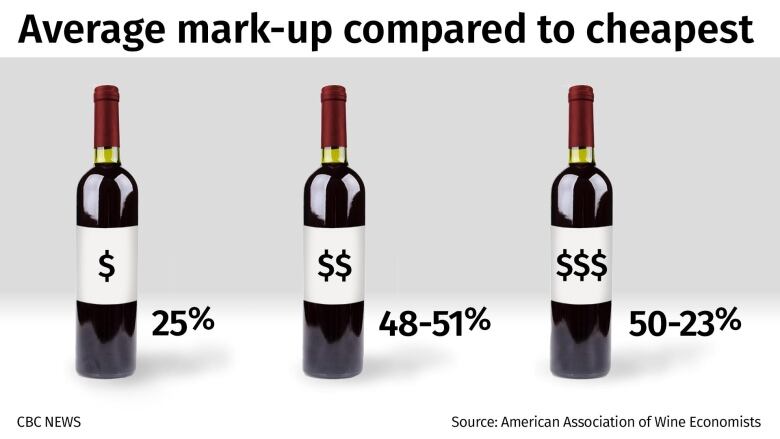
But according to his research, the theory doesn't hold up — the second-cheapest bottle of wine on the menu is actually a decent value, with the markup only about 25 per cent more than one would pay for the cheapest bottle of plonk on the menu.

"To be fair, you are being ripped off if you buy bottles of wine in the restaurant. But the question is: Is the second-cheapest particularly bad? And no, it's not particularly," Pathania said.

The researchers discovered that the markup on wine tends to peak in the middle of the wine list, while the wines at the bottom and top of the price scale often offer the best value. (CBC)

Where diners really get corked, the data suggests, is when they order wines numbered three through six on the menu. Then the markup can be more than 50 per cent higher, on average, than the best bargain on the list.

Markups in absolute terms are obviously higher for the most expensive bottles, but in percentage terms, higher-end wines are actually often a better value than the cheap offerings, the data suggests.

Even better news for frugal foodies is that the cheapest wine does actually tend to be the best value. "The cheapest is actually a relatively low markup, then the second-cheapest is slightly higher. Third is even higher. It kind of peaks in the middle, and then towards the high end, the markups start falling again," Pathania explained. 

Rules different in Canada

Toronto restaurateur Suzanne Barr has run kitchens and restaurants around the world, including more than one in Canada, and she says while it's true that alcohol sales can be a reliable money-maker for restaurants, they are less of a cash cow in Ontario because of the way the province regulates alcohol via the LCBO.

Unlike many other jurisdictions where restaurants pay wholesale rates, for the most part any business selling alcohol in Ontario pays the same price as drinkers. "What a lot of people don't understand is that glass of wine that we're selling for $15, we're maybe making, I don't know, $3 or $4 off of," she said in an interview.

Barr says most restaurant owners craft a wine list the same way they craft a menu, to make sure it follows a theme and goes with the overall atmosphere of the place. But they are obviously aware that there's money to be made on some bottles over others.

"It's like having a [go-to] dish on the menu," she said. "It's not gonna cost us that much to make, but we know we're gonna sell a whole ton of these."

Barr says that with the return of restaurant dining, she suspects customers will be compelled to splurge more than they did before the COVID-19 pandemic and buy that expensive bottle to treat themselves after they've been stuck eating at home for so long. "Because maybe when I go to the LCBO or the Wine Rack, I'm just gonna get that Yellowtail because that's really what I can afford."

WATCH | Suzanne Barr says pandemic has left diners in the mood to treat themselves: 
Toronto-based restaurateur Suzanne Barr says she expects people will be more willing than usual to spend big while dining out after being cooped up at home for more than a year during the pandemic. 0:48

Only time will tell what diners do as they return to eating in restaurants for the first time in more than a year in many parts of Canada, but Pathania's research offers some helpful advice for the millions of diners about to take the plunge.

"I have a rule of thumb: If you're paying the bill and you think the cheapest is drinkable, go for the cheapest," he said.

But given that high-end wines are often less marked up in percentage terms than the cheapest ones, "if there's a wine you really like and you know your wine, then go for it."

Adblock test (Why?)


https://news.google.com/__i/rss/rd/articles/CBMiSGh0dHBzOi8vd3d3LmNiYy5jYS9uZXdzL2J1c2luZXNzL3dpbmUtYm90dGxlLW1hcmt1cC1yZXN0YXVyYW50LTEuNjA4NzI3MdIBIGh0dHBzOi8vd3d3LmNiYy5jYS9hbXAvMS42MDg3Mjcx?oc=5

2021-07-04 08:00:00Z
CBMiSGh0dHBzOi8vd3d3LmNiYy5jYS9uZXdzL2J1c2luZXNzL3dpbmUtYm90dGxlLW1hcmt1cC1yZXN0YXVyYW50LTEuNjA4NzI3MdIBIGh0dHBzOi8vd3d3LmNiYy5jYS9hbXAvMS42MDg3Mjcx

Sabtu, 03 Juli 2021

Nova Scotia reports 8 new cases of COVID-19 Saturday - CBC.ca

Nova Scotia reported eight new cases of COVID-19 on Saturday to bring the total number of active cases in the province to 52.

There were four cases in the central health zone, all close contacts of previously reported cases.

The other four cases were in the eastern zone. Three are close contacts of previously reported cases and one is under investigation.

Two people are hospitalized with the virus, none in intensive care.

Nova Scotia health labs conducted 2,913 COVID-19 tests on Friday.

In a news release, Premier Iain Rankin warned Nova Scotians to not become complacent as Saturday's figure was higher than the numbers reported on previous days.

"While we've seen case numbers in the single digits over the past few days, today's number is a reminder that we can't let our guard down," Rankin said.

Atlantic Canada case numbers

  • New Brunswick reported no new cases Saturday. It has 22 active cases.
  • Newfoundland and Labrador reported one new case Friday. It has four active cases.
  • P.E.I. reported one new case Tuesday. It was the first new case since June 3.
MORE TOP STORIES 

Adblock test (Why?)


https://news.google.com/__i/rss/rd/articles/CBMibWh0dHBzOi8vd3d3LmNiYy5jYS9uZXdzL2NhbmFkYS9ub3ZhLXNjb3RpYS9jb3ZpZC1zYXR1cmRheS1jYXNlcy1hY3RpdmUtdmFjY2luZS1ub3ZhLXNjb3RpYS1ob3NwaXRhbC0xLjYwODkxNjXSASBodHRwczovL3d3dy5jYmMuY2EvYW1wLzEuNjA4OTE2NQ?oc=5

2021-07-03 18:39:14Z
52781711393021

Nova Scotia reports eight new cases of COVID-19 Saturday, active cases rise to 52 - CTV News Atlantic

HALIFAX -- Nova Scotia is reporting eight new cases of COVID-19 Saturday, as well as three recoveries, as the active number of cases in the province rises to 52.

Four new cases were identified in the Central zone, involving close contacts of previously reported cases.

The four other cases were identified in the Eastern Zone, three involving close contacts of previously reported cases and one remains under investigation.

"I encourage all Nova Scotians to get tested regularly and ensure you continue to keep a physical distance and wear a mask. Get both doses of your vaccine as soon as you can, if you haven't already," said Dr. Robert Strang, Nova Scotia's chief medical officer of health in a release. "Doing all of this will help limit spread of the virus and allow us to have a more normal summer." 

Public Health says there is now “limited community spread” in the Central zone. The Eastern, Northern and Western zones continue to be closely monitored for community spread.

"While we've seen case numbers in the single digits over the past few days, today's number is a reminder that we can't let our guard down," said Premier Iain Rankin. "This morning I dropped into the Fall River Shoppers Drug Mart, and owner Brian MacDonald told me about how well the vaccination program is rolling out. Thanks to him and all of our pharmacies for being part of our vaccine program and success in keeping COVID case numbers low. Get vaccinated; get tested." 

CASE DATA

Nova Scotia labs processed 2,913 tests on Friday, and have now processed a total of 951,797 since the start of the pandemic.

There have been 5,850 cumulative COVID-19 cases in Nova Scotia. Of those, 5,706 people have recovered, and 92 have died due to COVID-19.

According to the province's online dashboard, there are currently two individuals in hospital, with no one in an intensive care unit.

Since April 1, there have been 4,108 positive COVID-19 cases and 26 deaths. Of the new cases since April 1, 4,030 are now considered resolved.

There are cases confirmed across the province, but most have been identified in the Central zone, which contains the Halifax Regional Municipality.

The provincial government says cumulative cases by zone may change as data is updated in Panorama, the province’s electronic information system.

The numbers reflect where a person lives and not where their sample was collected.

  • Western zone: 290 cases (no active cases)
  • Central zone: 4,642 cases (38 active cases)
  • Northern zone: 301 cases (no active cases)
  • Eastern zone: 617 cases (14 active cases)

The provincial state of emergency, which was first declared on March 22, 2020, has been extended to July 11, 2021

VACCINE UPDATE

The province's COVID-19 online dashboard provides an update on the number of vaccines that have been administered to date.

As of Friday, 961,653 doses of the COVID-19 vaccine have been administered, with approximately 72.9 per cent of the province's overall population having received at least one dose. Of those, 253,331 Nova Scotians have received their second dose.

The province says it has received a total of 1,081,070 doses of COVID-19 vaccine since Dec. 15.

All Nova Scotians are encouraged to get vaccinated against COVID-19 as soon as they are eligible. COVID-19 vaccination appointments can be made online or by phone at 1-833-797-7772.

MORE WALK-IN TESTING OPTIONS

Nova Scotia health is introducting several new walk-in testing centres and mobile units across the province. 

Testing is open to anyone and can be convenient for out-of-province visitors arriving in Nova Scotia, public health said in a release.

A list of locations offering walk-in PCR COVID-19 testing in addition to testing by appointment can be found on the health authority's website. Rapid tests will not be offered at these locations.

Testing is available for all ages, for those who have symptoms, no symptoms (asymptomatic), have travelled or been to a potential exposure site and have been a close contact with a positive COVID case.

Public health is strongly encouraging Nova Scotians to seek asymptomatic COVID-19 testing, particularly if they have had several social interactions, even with their own social circle.

COVID-19 tests can be booked through the province's online self-assessment COVID-19 tool, or by calling 811.

People can also visit one of Nova Scotia’s rapid pop-up testing sites that continue to operate throughout the province.

Saturday, July 3:

  • East Preston Recreation Centre (24 Brooks Dr, East Preston) from noon to 7 p.m.
  • Richard Murray Design Building (5257 Morris St., Halifax) from 4 p.m. to 8 p.m.
  • Halifax Convention Centre (1650 Argyle St, Halifax) from noon to 7 p.m.
  • Bedford-Hammonds Plains Community Centre (202 Innovation Dr., Bedford) from 12 p.m. to 7 p.m.
  • St. Theresa's Parish Hall (285 St. Peter's Road, Sydney) from 2 to 7 p.m.

COVID ALERT APP

Canada’s COVID-19 Alert app is available in Nova Scotia.

The app, which can be downloaded through the Apple App Store or Google Play, notifies users if they may have been exposed to someone who has tested positive for COVID-19.

LIST OF SYMPTOMS

Anyone who experiences a fever or new or worsening cough, or two or more of the following new or worsening symptoms, is encouraged to take an online test or call 811 to determine if they need to be tested for COVID-19:

  • Sore throat
  • Headache
  • Shortness of breath
  • Runny nose/nasal congestion  

Adblock test (Why?)


https://news.google.com/__i/rss/rd/articles/CBMidmh0dHBzOi8vYXRsYW50aWMuY3R2bmV3cy5jYS9ub3ZhLXNjb3RpYS1yZXBvcnRzLWVpZ2h0LW5ldy1jYXNlcy1vZi1jb3ZpZC0xOS1zYXR1cmRheS1hY3RpdmUtY2FzZXMtcmlzZS10by01Mi0xLjU0ODgyMTjSAQA?oc=5

2021-07-03 17:42:37Z
52781711393021