Jumat, 02 Juli 2021

Germany issues world's strongest recommendation for mixing COVID-19 vaccines - CTV News

Germany has issued what appears to be the strongest recommendation anywhere for the mixing of COVID-19 vaccines on efficacy grounds.

The German Standing Committee on Vaccination (STIKO) said Thursday that people who receive a first dose of the Oxford-AstraZeneca vaccine "should get an mRNA vaccine as their second dose, regardless of their age."

This makes Germany one of the first countries to strongly recommend that people who have received a first dose of AstraZeneca receive either a Pfizer-BioNTech or Moderna vaccine as their second dose.

German Chancellor Angela Merkel helped pave the way for mixed vaccine use when she received the Moderna shot in June as her second dose following a first dose of the AstraZeneca vaccine.

STIKO said that "current study results" show that the immune response generated after a mixed dose vaccination "is clearly superior."

The mRNA vaccines currently approved by the European Medicines Agency (EMA) are Pfizer-BioNTech and Moderna.

Canada's National Advisory Committee on Immunization made a weaker recommendation on June 17 when they said that "an mRNA vaccine is now preferred as the second dose for individuals who have received a first dose of AstraZeneca/COVISHIELD vaccine."

'BETTER IMMUNE RESPONSE'

The Canadian committee said it was making the recommendation based on "emerging evidence of a potentially better immune response from this mixed vaccine schedule."

A study carried out by researchers at the University of Oxford and published June 28 found that "alternating doses of the Oxford-AstraZeneca and Pfizer-BioNTech vaccines generate robust immune responses against COVID-19."

According to a University of Oxford press release, the paper found that "both 'mixed' schedules (Pfizer-BioNTech followed by Oxford-AstraZeneca, and Oxford-AstraZeneca followed by Pfizer-BioNTech) induced high concentrations of antibodies against the SARS-CoV-2 spike IgG protein when doses were administered four weeks apart."

The EMA said in a press briefing on Thursday that although they are not "not in a position to make any definitive recommendation on the use of different COVID-19 vaccines for the two doses" there is a "strong scientific rationale" behind the approach.

Marco Cavaleri, head of Biological Health Threats and Vaccines Strategy for the EMA, told the briefing that the agency is "aware of the preliminary results from studies conducted in Spain and Germany" that "show that this strategy achieves satisfactory immune response and no safety concerns."

Also making reference to the recent Oxford data, Cavaleri said the EMA would continue to review the data as it becomes available.

Cavaleri affirmed that although the EMA makes recommendations "based on all the available evidence on the benefits and risk of a specific vaccine," the responsibility for how the vaccination should be administered falls to "the expert bodies guiding the vaccination campaigns in each member state."

Some European countries have previously administered mRNA vaccines as the second dose following a first dose of AstraZeneca on health and safety grounds, rather than for efficacy.

Following concerns about potentially fatal blood clotting incidents, countries such as Germany and Spain recommended that people under the age of 60 who received a first dose of AstraZeneca should a receive a mRNA dose for their second dose.

In making their recommendation on May 21, the Spanish Bioethics Committee said that although they recommended people who had a first dose of the AstraZeneca vaccine to receive a second dose of an mRNA vaccine, they would prefer people taking a second dose of AstraZeneca over no second dose at all.

NEW WAVE FEARS

Germany's updated guidance comes as the World Health Organization (WHO) warned that Europe was risking a new wave in August due to the relaxation of restrictions, the spread of an infectious COVID-19 variant and low vaccination coverage.

"Last week, the number of cases rose by 10 per cent, driven by increased mixing, travel, gatherings and easing of social restrictions," Hans Kluge, WHO Regional Director for Europe, said Thursday in a statement, as he warned that the Delta variant would be dominant in the region by the end of the summer.

Some 63 per cent of Europeans are waiting for their first jab, he said. yet Europe "will still be mostly restriction-free, with increasing travels and gatherings" in August.

"The three conditions for a new wave of excess hospitalizations and deaths before the autumn are therefore in place: new variants, deficit in vaccine uptake, increased social mixing," he said. "There will be a new wave in the WHO European region unless we remain disciplined, and even more so when there are far fewer rules in place to follow -- and unless we all take the vaccine without hesitation when it is our turn."

Kluge stressed two doses of the vaccine were effective against the Delta variant. "But the truth is that the average vaccine coverage in the region is 24 per cent only, and more serious, half of our elders and 40 per cent of our health care workers are still unprotected," he said.

"With these figures, nowhere is the pandemic over, and it would be very wrong for anyone -- citizens or policy makers -- to assume that it is," he said.

Adblock test (Why?)


https://news.google.com/__i/rss/rd/articles/CBMigAFodHRwczovL3d3dy5jdHZuZXdzLmNhL2hlYWx0aC9jb3JvbmF2aXJ1cy9nZXJtYW55LWlzc3Vlcy13b3JsZC1zLXN0cm9uZ2VzdC1yZWNvbW1lbmRhdGlvbi1mb3ItbWl4aW5nLWNvdmlkLTE5LXZhY2NpbmVzLTEuNTQ5NDA4MdIBRGh0dHBzOi8vYmV0YS5jdHZuZXdzLmNhL25hdGlvbmFsL2Nvcm9uYXZpcnVzLzIwMjEvNy8yLzFfNTQ5NDA4MS5odG1s?oc=5

2021-07-02 15:09:21Z
52781706660339

OPEC+ fights over oil output with inflation outlook at stake - BNN

OPEC+ allies were locked in a tense diplomatic standoff on Friday after a dispute that threatens to send oil prices sharply higher.

As of Friday afternoon in London, the group had failed to find a way out of the impasse, with both sides entrenched in their demands, delegates said. If the negotiations fail, the fallback position is that there’ll be no increase in output, one of them said. That would squeeze an already tight market, risking a further inflationary price spike.

“If OPEC+ fails to reach a compromise, the automatic fallback will be to roll over current quotas into August and beyond,” said Matthew Holland, a geopolitical analyst at consultant Energy Aspects Ltd. “That would lead to sharply higher prices, something most OPEC+ members want to avoid.”

Embedded Image

Ministers reconvened on Friday after the meeting was halted the evening before because of the dispute. It’s not the first time the group has faced such crises, and more often than not it has been able to fudge a diplomatic solution.

The disagreement centers on how the group measures its production cuts, with the United Arab Emirates refusing to back a deal to raise output unless the baseline for its own curbs is increased, according to delegates. The UAE is ready to accept no change in output for August if an agreement can’t be reached, one delegate said. It’s not clear if that stance would be acceptable to Russia, however.

On Thursday, the Organization of Petroleum Exporting Countries and its allies had appeared to be heading for a deal to add about 400,000 barrels a day of crude to the market each month from August to December. But the UAE put up objections at the last minute and the online meeting was paused.

Resolution may not be easy, because giving the UAE what it wants -- essentially a much higher production limit -- could upend the entire OPEC+ deal that’s buttressed oil prices since the start of the COVID-19 pandemic.

“Any request to adjust the production quota would be like opening Pandora’s box,” said Giovanni Staunovo, a commodity analyst at UBS Group AG. That could allow an output increase of about 700,000 barrels a day for the UAE alone, and “other OPEC+ states might also request an adjustment.”

Several delegates said the issue was so serious that it could only be resolved by talks at the highest level of government.

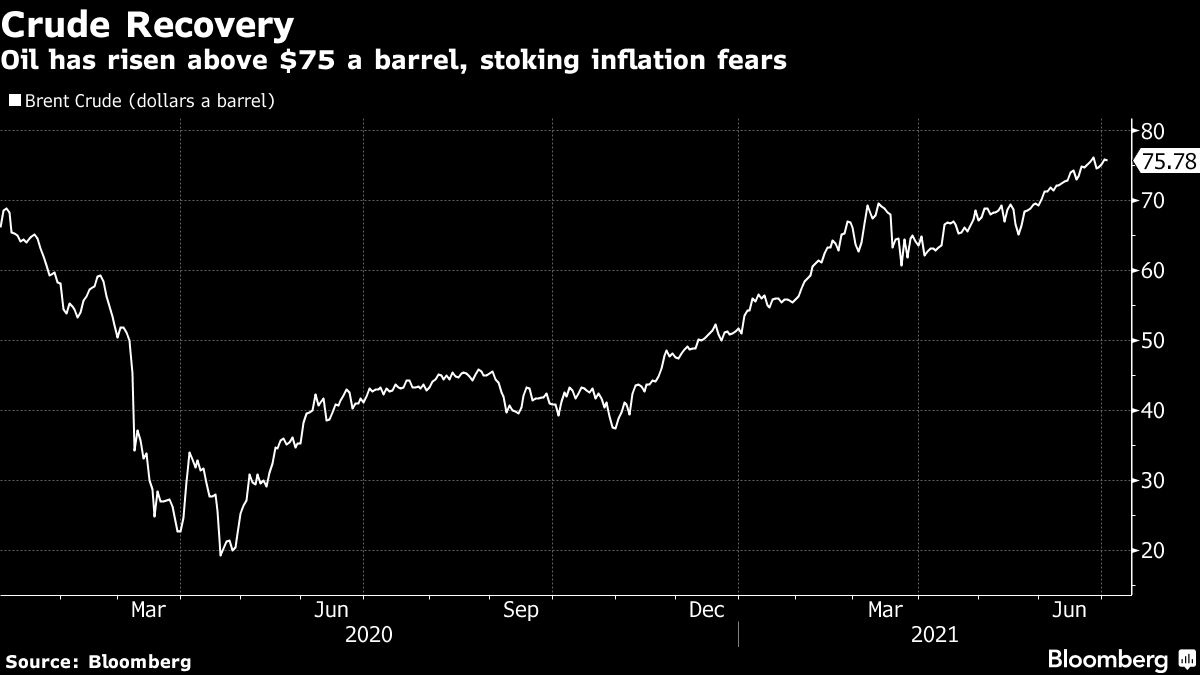
The standoff leaves the market unsure whether it will be grappling with a huge supply deficit in the second half of the year, with crude this week rising above US$75 a barrel in New York for the first time since 2018. It also tarnishes the cartel’s carefully reconstructed reputation, raising the specter of another destructive internal dispute -- the Saudi-Russia price war that helped to crash the oil market last year.

The UAE’s ambitions have upset negotiations before. Late last year, Abu Dhabi even floated the idea of leaving the cartel as it pressed to raise production. An OPEC meeting was postponed then too amid fraught negotiations, though a deal was ultimately struck.

The problem is a consequence of the UAE’s heavy investment in new additional capacity. The country’s cuts are measured from a starting point in 2018, setting its maximum capacity at about 3.2 million barrels a day. Expansion projects have since raised that number and the country wants its baseline reset to about 3.8 million barrels a day so it can use its new fields, delegates said.

The UAE argues that the change is necessary because, under the current terms of the OPEC+ deal, it is making proportionally deeper cuts than other members. The proposal on Thursday to delay the expiry of the output curbs from April to December 2022 exacerbated the issue.

“Clearly, the UAE is playing hardball and has signaled previously its frustration with production levels,” said Neil Quilliam, associate fellow in the Middle East and North Africa program at the Chatham House think tank. “It is unlikely that the UAE is willing to derail negotiations, this time around, though its appetite for doing so is growing, and future rounds are likely to be spikier.”

Red lines

For the UAE, the baseline is a very significant issue and it will reject the OPEC+ deal until there’s a change, a delegate said after the meeting was adjourned. The Saudis are equally insistent that the extension of the agreement until December 2022 is vital for market stability next year.

Failure to bridge the gap would leave the existing OPEC+ deal in place, keeping as much as 5.8 million barrels a day off the market until April 2022.

Oil has risen around 50 per cent this year, with the recovery in demand from the pandemic outpacing the revival of OPEC+ supplies after last year’s deep cuts. Crude’s surge, combined with a rally in other commodities, has central banks fretting about inflation again. Brent was broadly flat on Friday.

OPEC+ is already in the process of reviving crude supplies halted last year in the initial stages of the pandemic. The 23-nation coalition decided to add about 2 million barrels a day to the market from May to July. But there was a growing clamor for the group to keep going.

The cartel’s own data show that once-bloated oil inventories are back down to average levels as a strong revival in fuel consumption continues. Demand in the second half will be 5 million barrels a day higher than in the first six months of the year, OPEC Secretary-General Mohammad Barkindo said on Tuesday.

“You still need around 2 million barrels a day at least for the second half of the year to just keep the market in a reasonable sense of supply and demand balance,” Neil Beveridge, a senior analyst at Bernstein Research, said on Bloomberg TV.

Adblock test (Why?)


https://news.google.com/__i/rss/rd/articles/CBMiYWh0dHBzOi8vd3d3LmJubmJsb29tYmVyZy5jYS9vcGVjLWZpZ2h0cy1vdmVyLW9pbC1vdXRwdXQtd2l0aC1pbmZsYXRpb24tb3V0bG9vay1hdC1zdGFrZS0xLjE2MjQ0MjHSAQA?oc=5

2021-07-02 15:36:32Z
52781694566580

Gold price jumps as U.S. job numbers beat expectations but unemployment rate rises in June - Kitco NEWS

(Kitco News) Gold rose to daily highs after the U.S. added more jobs than expected in June but the unemployment rate ticked up.

U.S. nonfarm payrolls rose by 850,000 in June, according to the Bureau of Labor Statistics. The monthly figure came well above market consensus estimates of 700,000.

However, the U.S. unemployment rate rose to 5.9%, while markets projected to see a drop to 5.7%. The number of unemployed also remained at 9.5 million.

“These measures are down considerably from their recent highs in April 2020 but remain well above their levels prior to the coronavirus (COVID-19) pandemic (3.5 percent and 5.7 million, respectively, in February 2020),” the report noted.

The most active sectors were leisure and hospitality, public and private education, professional and business services, and retail trade.

The labor force participation rate was unchanged at 61.6% in June. Meanwhile, wages, another key element in the report, edged down, with average private wage growth coming in at 0.3% May’s 0.4% advance.

"The mix of jobs added being tilted towards lower-paying services resulted in average private wage growth decelerating to 0.3%, despite those services seeing notable upward pressure on wages due to the labor shortage," said CIBC Capital Markets economist Katherine Judge.

Gold prices moved higher and neared daily highs after the data were released. August Comex gold futures were last trading at $1,790.90, up 0.79% on the day. 

Live 24 hours gold chart [Kitco Inc.]

Adblock test (Why?)


https://news.google.com/__i/rss/rd/articles/CBMihgFodHRwczovL3d3dy5raXRjby5jb20vbmV3cy8yMDIxLTA3LTAyL0dvbGQtcHJpY2UtcmVzaWxpZW50LWFzLVUtUy1qb2ItbnVtYmVycy1iZWF0LWV4cGVjdGF0aW9ucy1pbi1KdW5lLXdpdGgtODUway1wb3NpdGlvbnMtYWRkZWQuaHRtbNIBAA?oc=5

2021-07-02 12:35:00Z
52781706968097

Pump prices expected to continue climb as oilpatch eyes better days ahead - CBC.ca

With oil prices recently returning to some of their highest levels in years, experts say drivers should prepare to pay even more at the pumps as the summer driving season begins.

Those higher crude prices may help lift hopes for better days in Canada's oilpatch, but it's also contributed to higher gasoline prices as fuel demand starts to take off.

"I'm always not wanting to fill it up all the way," said Peter Bleumortier, while fuelling a pickup truck last weekend in Vancouver, where prices had climbed to $1.70 a litre. "It's like breaking the bank."

The North American benchmark oil price has marched from below $50 US per barrel at the start of the year to well over $70 US a barrel more recently, nearing 2018 highs. It has had some talking again about $100 a barrel oil by next year.

It comes as the market broadly expects COVID-19 vaccines to bolster global oil demand, though there are concerns over the potential impact of the new delta variant

Markets will be watching Friday when the oil-producing nations of OPEC are expected to decide how much to increase crude output over the coming months.

Canadian gasoline prices have also reached some of their highest levels in the last five to seven years, according to Patrick De Haan, head of petroleum analysis at GasBuddy.

A year ago, in April 2020, the average gasoline price in the country had plunged to 76 cents, he said. Earlier this week, the average Canadian gasoline price was around $1.36 per litre, according to GasBuddy.

And De Haan believes pump prices could continue climbing for a while yet.

GasBuddy's Patrick De Haan doesn't expect higher prices to hold back consumer demand, with people itching to hit the road.

"We will probably not see a peak in price for another potentially four weeks as demand is likely to continue to increase," De Haan said in an interview this week.

"Keep in mind that the pandemic is just beginning to really ease in Canada. And over the next four weeks, as more people feel better about getting out, they're going to do so."

He doesn't expect higher prices to hold back consumer demand.

"Even if [gasoline] prices do reach record highs, I don't think that many Canadians are going to be persuaded to stay home this summer," he said.

The rise in fuel and oil prices may also affect the price of other goods, like airline tickets, groceries and other commodities, De Haan said. 

Economist Rory Johnston said higher oil prices can also help lift the value of the dollar, as well as government revenues from taxes and energy royalties.

"I think that the Canadian oilsands are also looking like they're going to have really, really strong cash flows, really strong profitability," said Johnston, managing director at the Toronto-based Price Street.

"That's going to mean higher corporate taxes. It's going to mean higher personal taxes for those people that are still on payroll." 

Higher oil prices are good news for oil companies aiming to rebuild their balance sheets after the sector borrowed heavily to survive a long downturn that saw thousands of layoffs.

Companies are also navigating a shifting energy landscape, including climate change, carbon policies and the long-term outlook for fossil fuel demand

Analyst Jeremy McCrea said while company cash flows are improving, he doesn't expect a big rebound in capital spending or employment in the industry this year.

"Jobs [will] come back a little bit," said McCrea, who is with Raymond James and based in Calgary. "You're going to see some spending pick up there, but very, very marginally."

PetroLMI’s most recent data shows a steady rise in the number of exploration and production jobs in Alberta, from December through May. (Todd Korol/Reuters)

This spring, PetroLMI's labour market outlook forecast "modest" growth in oil and gas jobs in Canada beginning next year, with recruitment for skilled workers becoming a concern.

The organization's most recent data shows a steady rise in the number of exploration and production jobs in Alberta from December through May.

Some say it feels like things are beginning to turn around now.

Adam Waterman, a service rig co-ordinator with Baytex Energy, said there are already signals things are picking up again.

"Across the province, I hear that we're iron rich and man poor," Waterman said recently while working at the site of a former natural gas well near Camrose, Alta. "I haven't been this bullish on Canadian energy for a lot of years."

Scott Darling, president of Performance Energy Services, said his company was already busy doing abandonment work on well sites. 

With $70 US oil, he thinks production work in the oilpatch will pick up again, increasing the competition for workers.

"People have left the province; [it's] really hard to attract them back," he said.

Adblock test (Why?)


https://news.google.com/__i/rss/rd/articles/CBMiRWh0dHBzOi8vd3d3LmNiYy5jYS9uZXdzL2J1c2luZXNzL29pbC1nYXNvbGluZS1wcmljZXMtY2FuYWRhLTEuNjA4NTEzMtIBIGh0dHBzOi8vd3d3LmNiYy5jYS9hbXAvMS42MDg1MTMy?oc=5

2021-07-02 08:00:00Z
CBMiRWh0dHBzOi8vd3d3LmNiYy5jYS9uZXdzL2J1c2luZXNzL29pbC1nYXNvbGluZS1wcmljZXMtY2FuYWRhLTEuNjA4NTEzMtIBIGh0dHBzOi8vd3d3LmNiYy5jYS9hbXAvMS42MDg1MTMy

Kamis, 01 Juli 2021

Oil Prices Jump As OPEC Reaches Preliminary Deal - OilPrice.com

Oil Prices Jump As OPEC+ Reaches Preliminary Deal | OilPrice.com
Tom Kool

Tom Kool

Tom majored in International Business at Amsterdam’s Higher School of Economics, he is Oilprice.com's Head of Operations

More Info

Premium Content

Russia and Saudi Arabia have reportedly reached a preliminary deal for OPEC+ to gradually increase output by 2 million barrels per day between August and December, Reuters said, citing an unnamed OPEC+ source.

This is this unofficial sourcing coming out of a meeting of the JMMC, which was still ongoing as of 13:00 EDT.

An OPEC panel has proposed monthly increases in output of 0.4 million barrels per day.

Updating on Twitter, Amena Bakr, Deputy Bureau Chief & Chief Opec Correspondent for EnergyIntel, reported that the JMMC was currently addressing some countries’ dissatisfaction with their existing baselines.

Bakr also noted, alongside Reuters, that the talk at the JMMC was for a potential 400,000 bpd per month increase from August to December, cautioning that there has been no official announcement that this proposal has been adopted as of yet.

Reuters also said that oil supply “management” could run into the end of next year.

As of the time of writing, sentiments were bullish, but Brent was pulling back slightly from its price of over $76 this morning, to $75.88 at 13:07 EDT. WTI is trading at $75.23. 

Overall, the market is liking it. The global economy is recovering, and both American shale producers and OPEC have demonstrated the right amount of restraint for the gradual increase proposal to be met with bullish sentiments.

“OPEC is looking like it’s going to keep some restraint, and to me, the market is in a really good place,” Bloomberg quoted Rebecca Babin, senior energy trader at CIBC Private Wealth Management, US, as saying. “People are very comfortable and constructive with the profile over the next year.”

Speaking to Agence France Presse, PVM analyst Stephen Brennock described OPEC’s strategy as “thus far spot on”, saying the cartel “has managed to restore the oil balance without over-tightening the market”.

By Tom Kool for Oilprice.com

More Top Reads from Oilprice.com:


Download The Free Oilprice App Today

Back to homepage


Related posts

Adblock test (Why?)


https://news.google.com/__i/rss/rd/articles/CBMiXGh0dHBzOi8vb2lscHJpY2UuY29tL0VuZXJneS9PaWwtUHJpY2VzL09pbC1QcmljZXMtSnVtcC1Bcy1PUEVDLVJlYWNoZXMtUHJlbGltaW5hcnktRGVhbC5odG1s0gFgaHR0cHM6Ly9vaWxwcmljZS5jb20vRW5lcmd5L09pbC1QcmljZXMvT2lsLVByaWNlcy1KdW1wLUFzLU9QRUMtUmVhY2hlcy1QcmVsaW1pbmFyeS1EZWFsLmFtcC5odG1s?oc=5

2021-07-01 17:19:55Z
52781694566580

Robinhood reports explosive growth, stock will trade as HOOD - Business News - Castanet.net

Robinhood, the trading app that’s sent a newly empowered generation of investors to Wall Street, saw its revenue soar 309% at the start of the year as a frenzy over so-called meme stocks shook the market.

The company revealed the revenue surge in a filing with the Securities and Exchange Commission Thursday, as it prepares to sell its own stock on the Nasdaq for the first time. It plans to trade under the symbol HOOD.

Robinhood’s initial public offering is set to be one of the most anticipated of the year, giving investors a chance to own part of a fast-growing company that has rocked the traditionally staid brokerage business. Since its launch in 2014, Robinhood’s popularity has forced rivals to get rid of commissions and to offer apps that make trading easy and maybe even fun.

But as it’s drawn in 18 million funded accounts, with more than half its customers first-time investors, the company has also faced a mountain of criticism from regulators and users alike. Robinhood has agreed to pay more than $130 million in recent years to settle accusations by regulators, with the most recent fine announced just a day earlier.

Among the accusations: It improperly allowed some users to make riskier trades than they were perhaps ready for; it failed to make clear to customers that it makes much of its money by routing their trades to Wall Street firms taking the other side; and its supervision of its technology was weak and helped lead to outages of its service.

But for all the controversy around it, Robinhood offers something that’s always in great demand on Wall Street: explosive growth.

The company's revenue soared to $522 million in the first three months of 2021, up from $128 million a year earlier. It's also coming off a profitable year. It had net income of $7 million in 2020 after losing $107 million in 2019.

Adblock test (Why?)


https://news.google.com/__i/rss/rd/articles/CBMiaWh0dHBzOi8vd3d3LmNhc3RhbmV0Lm5ldC9uZXdzL0J1c2luZXNzLzMzODc1Mi9Sb2Jpbmhvb2QtcmVwb3J0cy1leHBsb3NpdmUtZ3Jvd3RoLXN0b2NrLXdpbGwtdHJhZGUtYXMtSE9PRNIBAA?oc=5

2021-07-01 18:19:00Z
52781705766179

Here's what you need to know for another pandemic Canada Day, including what is open and closed - CP24 Toronto's Breaking News

Canada Day will once again be upended by the COVID-19 pandemic this year with no fireworks displays planned and most tourist attractions remaining closed.

The good news is that a wide range of outdoor activities are now permitted with Ontario in step two of its reopening plan. Shopping malls are also permitted to open in step two, though most will be closed due to the holiday.

Here is what you need to know for this Canada Day:

Open

  • Outdoor swimming pools (Capacity has been increased to 50 per cent at Toronto’s 58 outdoor pools)
  • Splash pads and wading pools
  • Golf courses
  • Riverdale Farm
  • High Park Zoo
  • Toronto Zoo
  • Toronto Island Park
  • Most beaches (Marie Curtis Park East Beach, Sunnyside Beach and Cherry Beach are closed due to unsafe levels of E. coli)
  • Select Beer Store locations (84 across the province are open)
  • Toronto Premium Outlets (9:30 a.m. to 7 p.m.)
  • Toronto Eaton Centre (11 a.m. to 7 p.m.)

Closed

  • All LCBO locations
  • Post offices
  • Banks
  • Government offices
  • Libraries
  • Indoor pools and community centres
  • Most tourist attractions
  • Most grocery stores
  • Most shopping malls, including Sherway Gardens, Scarborough Town Centre and Yorkdale Shopping Centre
  • St. Lawrence Market

Transit

The TTC is operating on their holiday service schedule while GO Transit is following their Sunday schedule

Other

The Toronto Sign will be lit in orange in solidarity with Indigenous communities across Canada.


Adblock test (Why?)


https://news.google.com/__i/rss/rd/articles/CBMiggFodHRwczovL3d3dy5jcDI0LmNvbS9uZXdzL2hlcmUtcy13aGF0LXlvdS1uZWVkLXRvLWtub3ctZm9yLWFub3RoZXItcGFuZGVtaWMtY2FuYWRhLWRheS1pbmNsdWRpbmctd2hhdC1pcy1vcGVuLWFuZC1jbG9zZWQtMS41NDkzMDc00gEA?oc=5

2021-07-01 11:09:00Z
52781707684293