Statistics Canada said Tuesday the economy grew at a record annualized pace of 40.5 per cent in the third quarter as businesses came out of COVID-19 lockdowns.
The previous record for quarterly growth in real gross domestic product was 13.2 per cent in the first quarter of 1965, the agency said.
As historic as the rebound was, it fell short of expectations.
Financial data firm Refinitiv said the average economist estimate was for an annualized growth rate of 47.6 per cent for the quarter.
The rebound over July, August and September was a sharp turnaround from the preceding three-month stretch, which saw a record drop.
Driving the rebound were the further rolling back of public health restrictions that allowed businesses to reopen.
Statistics Canada also said there was a substantial increase in the housing market owing to low interest rates, as well as household spending on goods like cars.
GDP still lower than it was in February
Despite the overall increase, the national statistics office said real gross domestic product still remains shy of where it was before the pandemic.
The third quarter ended with the fifth consecutive monthly increase in real GDP after the steepest monthly drops on record in March and April when widespread lockdowns were instituted to slow the spread of COVID-19.
September saw a 0.8 per cent increase in real GDP, Statistics Canada said, a slight slowing from the 0.9 per cent recorded in August.
The agency also provided a preliminary estimate for October's figures, saying early indicators point to a 0.2 per cent increase in the month. The figure will be finalized at the end of this month.
"The fourth quarter of 2020 is still beginning with some growth, though less than we had anticipated," CIBC senior economist Royce Mendes wrote in a note.
"Looking ahead, the economy faces a December with harsh restrictions that will likely see another contraction in economic activity."
Statistics Canada says the economy grew at a record annualized pace of 40.5 per cent in the third quarter as businesses came out of COVID-19 lockdowns.
Financial data firm Refinitiv says the average economist estimate was for an annualized growth rate of 47.6 per cent for the quarter.
The rebound over July, August and September was a sharp turnaround from the preceding three-month stretch saw a record drop.
Driving the bounce-back were the further rolling back of public health restrictions that allowed businesses to reopen.
Statistics Canada also says there was a substantial increase in the housing market owing to low interest rates and household spending on goods like cars.
Despite the overall increase, the national statistics office says real gross domestic product still remains shy of where it was before the pandemic.
The Canadian economy roared back to life in the third quarter, recording its biggest ever expansion, but it was a lower than expected increase and early data show the momentum is quickly cooling amid a second wave of COVID-19.
Gross domestic product rose by an annualized 40.5 per cent in the July to September period, Statistics Canada reported Tuesday in Ottawa, erasing much of the record 38.1 per cent drop in the second quarter. Economists were predicting a 48 per cent increase. The rebound brings total output to 95 per cent of end of 2019 levels.
Early success controlling the spread of the virus allowed the economy to rebound quickly, as massive government aid propelled consumer spending and low interest rates fueled a surge in the housing market. However, a flash estimate puts growth at 0.2 per cent in October, a sign measures imposed to reduce the spread of COVID-19 are already halting momentum.
Household consumption was a key driver in the third-quarter, rising 63 per cent annualized. Residential investment surged 187 per cent on the back of strong housing starts and renovations.
The quarter ended on a relatively strong note with September GDP rising 0.8 per cent. Economists were expecting 0.9 per cent growth.
Bank of Montreal soared past analyst expectations in its fiscal fourth quarter amid a sharp improvement in credit quality and double-digit profit growth in its capital markets unit.
BMO said Tuesday it earned $1.6 billion in net income during the three months that ended Oct. 31, compared to $1.2 billion a year earlier. On an adjusted basis, the bank logged $2.41 in profit per share. Analysts, on average, were expecting $1.91.
The bank set aside $432 million during the latest quarter for loans that could eventually go bad. That was down sharply from $1.05 billion in the previous quarter.
Compared to the fourth quarter a year earlier, BMO's capital markets business was the star performer as adjusted profit surged 38 per cent to $387 million.
Wealth management operations also delivered year-over-year growth, as adjusted profit in that unit rose nine per cent to $328 million.
In absolute terms, profit from BMO's Canadian personal and commercial (P&C) business dwarfed those units at $647 million in the fourth quarter. While that was down nine per cent from the same quarter in 2019, it was more than double profit from the fiscal third quarter.
It was a similar theme in BMO's U.S. P&C division, where adjusted profit fell 17 per cent year-over-year to US$253 million -- but that also represents a 27-per-cent jump from the previous quarter.
"We entered the year in a strong position with good momentum across our businesses,” said BMO CEO Darryl White in a release. “Throughout the challenges brought on by the pandemic, we have been on the front line of the economic recovery, supporting our customers, communities and employees through uncertainty and hardship.”
“Our results for the year are a testament to the resilience and diversification of our businesses and our ability to quickly adapt to the evolving environment.”
While his daughter and her Grade 3 class were cleared to return to school on Monday, his son's Grade 2 class must self-isolate for 14 days, even though the youngster himself was among those who tested negative.
The weekend's testing blitz at Thorncliffe Park Public School — the first Toronto District School Board (TDSB) location selected for the voluntary testing pilot announced last week — saw 14 classes affected and sent home for two weeks. However, the rest of the school will remain open, according to direction from Toronto Public Health.
Nadaf is rolling with it, saying he believes teachers and staff have been trying their best to maintain health and safety precautions and protocols.
"What can we do? This is going on everywhere in the world," he said. "They try their best, but at the same time they cannot prevent it completely."
Testing asymptomatic students and staff is currently being offered at designated schools in Toronto, Peel and York regions and Ottawa — four Ontario regions with a high number of active COVID-19 cases.
Thorncliffe Park Public School was the first Toronto District School Board location selected to participate in a new voluntary asymptomatic testing program at schools in four COVID hot spots in Ontario. The testing found 19 positive cases, and 14 classes were sent home to self-isolate. (CBC)
The goal is to improve tracking of the coronavirus and prevent transmission within schools, as well as to inform future public health decisions. While parents and health experts seem to be applauding the pilot, some are also highlighting shortcomings in how it's being rolled out.
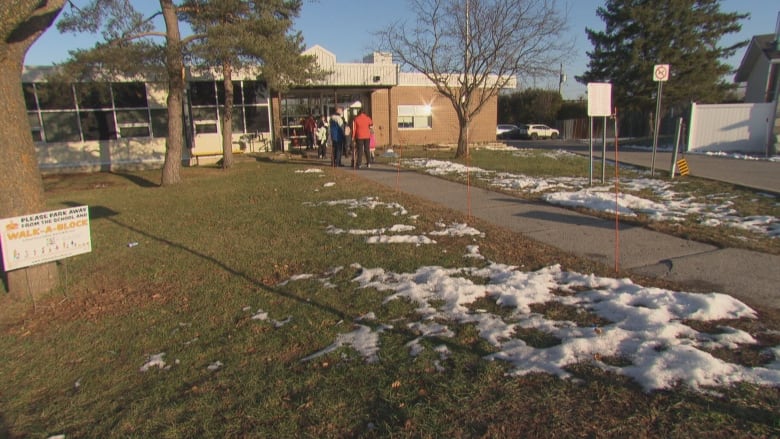
Over the weekend, testing also began in Ottawa at Manordale Public School, part of the Ottawa-Carleton District School Board. Amber Mammoletti, an occasional teacher working at two schools this fall, dropped by on Sunday to be tested with her son, Flynn.
"I think there's people walking around not realizing they have it — no symptoms — so it's just better to keep everyone safe: Get tested if you can and see what happens," she said.
WATCH | How testing helped Cornell University become a model of COVID-19 prevention:
At the start of the school year, Cornell University implemented a strategy of regular testing and robust contact tracing on campus. The plan was expensive, but it’s prevented any major COVID-19 outbreaks at the New York institution. 8:19
School boards are working with local public health authorities to determine which schools to target over the next four weeks, but the expectation is that new positives will undoubtedly emerge, TDSB spokesperson Ryan Bird said.
"The 19 cases we've learned about over the weekend [at Thorncliffe Park PS] as a result of the testing is a concern, but it's not unexpected," he said Monday.
"While this information is concerning, it really is the information that our public health officials need to know, because it gives them a better snapshot of how many of those asymptomatic people are positive cases of COVID."
Despite the batch of positive cases arising from this first weekend, Ontario Education Minister Stephen Lecce reiterated his assertion that "99.9 per cent of Ontario students are COVID-free" during a press briefing on Monday afternoon.
Acknowledging that "we still have work to do" in tracking COVID-19 cases in communities, he characterized the new testing initiative as an extension of the existing safety measures his ministry had announced.
"The fact that hundreds of children, students and staff have gotten tested [at Thorncliffe Park PS] in conjunction with the local public health unit I think underscores that the plan in place is ... working hard to mitigate any further spread: identifying COVID cases, isolating them or moving them from the school, so we don't have spreaders within the school."
'Canaries in the coal mine'
A targeted campaign of testing in schools — which in most neighbourhoods are considered trusted, known places — is a welcome tool that adds to the barometer of what's happening in the communities they're located in, said Dr. Zain Chagla, an infectious diseases physician and assistant professor at McMaster University in Hamilton.
"Parents who may not be encouraged to go get tested in their local communities will readily take their kids to the school, which is a place they know," he said.
"Things like this are going to be canaries in the coal mine. You kind of get a better sense of what's happening in the community by doing these local testing strategies."
Manordale Public School in Ottawa was also among the schools selected for the pilot project. Students and staff lined up on Sunday for testing. (CBC)
He added the caveat, however, that the type of test being used will likely cause more chaos for families and schools.
For the pilot, Ontario is using PCR testing, which detects the genetic material of a virus. Although considered the gold standard, it's also so sensitive it would "pick up kids who are infectious, as well as kids who were infectious two, four, six weeks ago," Chagla said.
He suggested that they could have chosen rapid antigen tests, which flag active infections by identifying proteins on the surface of infectious virus particles.
The rapid antigen tests may offer a more precise picture "of who is really a threat to the community versus who had COVID six weeks ago, where they're not really a threat," Chagla said.
WATCH | Nova Scotia offers rapid COVID-19 tests in Halifax for asymptomatic cases:
Health officials in Nova Scotia offered rapid COVID-19 testing in Halifax to reduce the virus’s spread in the province by catching asymptomatic cases. 2:01
Though Toronto parent Jessica Lyons welcomes the introduction of asymptomatic testing, she said it comes months late and should be offered more widely.
"This is desperately needed," said the mother of two school-aged children and an organizer with the Ontario Parent Action Network.
"Much more testing in schools — to make it accessible, to make it easy for parents and families and students to do — is really essential. So we support this pilot, obviously, but we think that it should have come ... weeks and weeks ago, and it needs to be expanded."
PCR testing being used in the pilot project is considered the gold standard, but it's also so sensitive it would 'pick up kids who are infectious, as well as kids who were infectious two, four, six weeks ago,' said Dr. Zain Chagla. (Craig Chivers/CBC)
Back in Thorncliffe Park, among the Toronto communities hardest hit by COVID-19 this year, parents in the neighbourhood expressed concern about the new positive cases found through the testing initiative. But they're also adamant about one thing: their schools staying open.
Remote learning last spring was "really hard for kids. We've seen the mental stress on our child and other kids," said Osamah Aldhad, father of a second grader who he said really missed being at school.
"When we were kids, you know, we used to run away from school," Aldhad noted.
"Now they're actually really wanting to go to school, which is really important for them."
Bank of Nova Scotia kicked off earnings season for Canada's Big Six lenders by handily beating profit expectations amid a sharp drop in funds set aside for loans that could go bad.
Scotia said Tuesday its fiscal fourth quarter net income was $1.9 billion, compared to $2.3 billion a year earlier. On an adjusted basis, it earned $1.45 per share. Analysts, on average, expected $1.22.
In a potentially encouraging signal about credit quality trends amid the second wave of COVID-19, the bank booked $1.13 billion in provisions for credit losses during the three months ending Oct. 31. While that was a 50-per-cent increase from a year earlier, it was a significant decline from the $2.18 billion that had been set aside in the previous quarter.
Scotia's core Canadian banking operations struggled in the quarter compared to the same time in 2019, with revenue falling four per cent year-over-year and adjusted profit sliding 13 per cent. The bank pointed out its net interest income came under pressure because of the Bank of Canada's rate cuts. On a sequential basis, the unit’s profit surged 81 per cent.
The bank's sprawling international operations rebounded in the quarter as adjusted profit hit $353 million from just $4 million in the fiscal third quarter.
Scotia's other primary operating units – wealth management and global banking and markets – each delivered year-over-year growth in adjusted profit.
"As we look forward to 2021, we will continue to put customers first and we remain cautiously optimistic that better times lie ahead as we continue to grow our presence as a leading bank in the Americas," said CEO Brian Porter in a release.